Clustering your Ancestry DNA matches with Excel (and DNAGedcom)

There are more and more good visualization tools available for clustering your DNA matches with the intent of discovering a new ancestor.  Recently I’ve been using a clustering tool created by Evert-Jan Blom at Genetic Affairs (more on that tool in an upcoming post). 

The DNA Color Clustering method used by Dana Leeds clustering methodology is straightforward, and especially effective for those persons who have many 2nd and 3rd cousin matches on Ancestry — which I don’t.  (Although it actually works quite well for more distant cousins, in my opinion, especially if you’ve been working on clustering your matches for several years!)  You can find out more about Dana’s method here.

Despite these cool clustering methods — and others — in the end, I keep returning to my trusty Excel spreadsheet and my list of “ICW” (In Common With) matches from Ancestry.com which I download using the DNAGedCom client tool (available here via a yearly subscription).

I’m sharing my way of clustering my matches — or, more specifically, my mother’s matches and my father’s matches — because the “best” method is the one that makes the most sense to you, or seems the most “intuitive”.
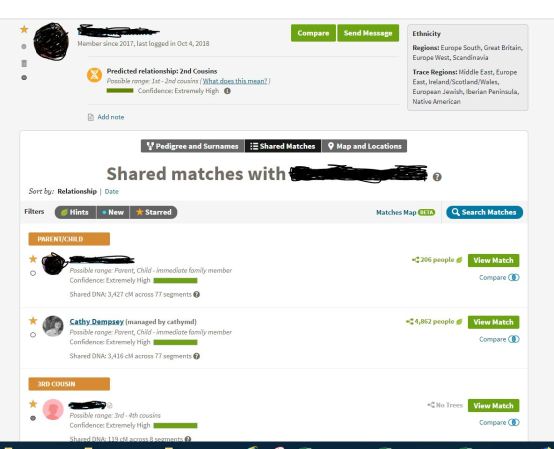
Mom_RitaShared

Some of Mom’s shared matches with “Cousin B”, on Ancestry

Let’s say I’m working with my mother’s DNA matches from Ancestry.com.  Using the DNAGedcom Client tool, I will download a list of all her matches, and then download a list of all her “ICW” matches into CSV format. 
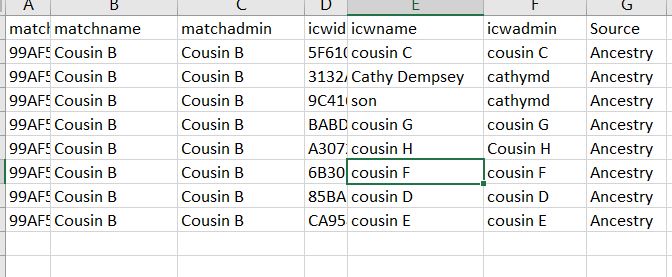
Default ICW file

This is a sample of the default ICW file, before I combine it with the default Match file.

Default Match file

This is an abbreviated sample of the default match file.  The columns of interest are “Range” and “SharedCM”.

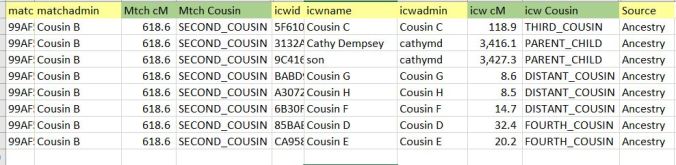
Once I have the two files, I use the VLOOKUP tool in Excel to associate (Cousin) Range and SharedCM to the primary match, and then to the In Common With matches.  The result is a combined file like that below.  The combined columns are highlighted in green.
Combined File

The “Mtch cM” and “Mtch Cousin” columns associate to Cousin B; the “icw cM” and “icw Cousin” associate to the ICW match: me, my brother, and cousins C, D, E, F, G, and H.  Shared cM (centiMorgans) = shared DNA; see my previous post here for more on centiMorgans. 

For purposes of clustering, though, all we really care about is that in general, the more DNA you share, the closer you are related — at least in the case of 2nd cousins or closer.  You can see that to some extent with Ancestry’s predicted ranges in the green highlighted columns.

The In-Common-With (ICW) list is basically a subset of your matches list.  My mom’s paternal first cousin — let’s call her “B” — has also tested at Ancestry.  So, Mom’s ICW list for “B” would include me, my brother, and six other cousins: C, D, E, F, G, H.  (Mom’s father was a first generation American, and “B”‘s father was born in Italy — not a lot of our Italian side, many still residing in Italy, have tested their DNA on Ancestry.  Hence, we don’t have a lot of matches.)  The critical point is that C, D, E, F, and G as well as my brother and I would show up on Mom’s match list AND on B’s match list — we are the “in common” matches.

So, if Mom and cousin “B” are first cousins, their Most Recent Common Ancestor(s) (MRCA) would be their shared set of (Italian) grandparents: Guiseppe Diamantini and Maria Bolognesi.  Obviously that same couple would be the great-grandparents of my brother and me.  But my brother and I are not the interesting cousins in the ICW cluster.  Cousins C, D, E, F, G and H are the key here. 

Mom_DNAGedCom_Example2

Let’s look at the example above.  I “cluster” my mom’s DNA matches by adding two columns (shown here highlighted in red).  Because I know my mom and Cousin B share the same set of grandparents, I put the MRCA couple’s name in the “Mtch MRCA” column for each row where there is an In Common With cousin.  (Note that, despite Ancestry’s prediction that my mom and Cousin B are 2nd cousins, they are in fact 1st cousins.)

The amounts of DNA shared, shown in the “Match cM” column and the “icw cM” column are the amounts Mom shares with these cousins.  We cannot determine from the information shown here how much, if any, “B” shares with “F”, or “C” shares with “D”.   We only know C, D, E, F, G, H not only share DNA with Mom, but MUST also share some amount with Cousin B because Ancestry has given us that information.

I then look at each of the ICW cousins: that is, my brother and I, plus cousins C through H.  I note that my brother and I are children, which means our DNA amounts won’t have any new information to determine cousin clustering — because whatever we share, we inherited from Mom.  (You can always exclude known children of a DNA match when you’re working with clustering, because they will always be a subset of their parents — if you have your parents or grandparents tested.)

Cousins C and D are two people whose place in my mother’s family tree I already know — therefore I include their MRCA information (Fortunato Camillucci and Maddelena Serafini).  They are my mother’s cousins on her Diamantini line.  Since the Diamantini line is my mother’s paternal line, I shade it blue for male.

Cousins E, F, G and H are unknown to me.  In this case, none of them have trees on Ancestry which might give me more detailed information as to how they relate to my mother.  The amount of DNA shared is fairly small, so it is possible the Most Recent Common Ancestor (MRCA) with Mom is quite a few generations back.  So I note them as “Diamantini or Bolognesi” (as I don’t yet know whether they share on the Diamantini line or the Bolognesi line) and also shade the cell in blue.  I leave those notes unbolded, since I’m not certain of how the cousin actually fits into our tree.

I then do the same thing with each of the other cousins listed here.  Below is a screen shot of the In-Common-With listing for Mom and Cousin C.  Note that there is some overlap with the In-Common-With listing for Mom and Cousin B, but there is one person who shares DNA with Mom and Cousin C, but who does not share with Cousin B.  I labeled that person Cousin J (highlighted in bright yellow.)

Bree_DNAGedCom_Example1Because the Most Recent Common Ancestor between Mom and Cousin C is the Camillucci & Serafini couple, I then use those names to populate the cell in the icw MRCA column, as shown below.

Bree_DNAGedCom_Example2

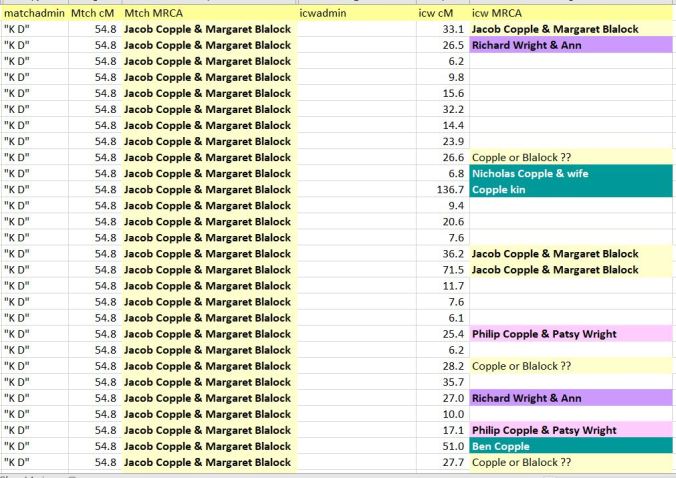
Mom doesn’t have that many matches on Ancestry.com to her paternal side, in part because her father was a 1st generation American.  A better example of the clustering is shown below, with one of her 4th cousins.  The shared Most Recent Common Ancestor between Mom and cousin “K D” is Jacob Copple and Margaret Blalock.
Cousin KD

I have hidden the names of the In-Common-With cousins, but you can see the amount of DNA they share with my mother.   What this screenprint shows is how the different In-Common-With cousins have different Most Recent Common Ancestors with Mom.  But all of them are related in some way to either Jacob Copple or Margaret Blalock.  Philip Copple and Patsy Wright, for instance, are the presumed parents of Jacob Copple.  Patsy Wright’s presumed grandparents are Richard Wright & Ann.  Ben Copple is the son of Jacob Copple & Margaret Blalock, while Nicholas Copple & wife are the likely paternal grandparents of Jacob’s father Philip.

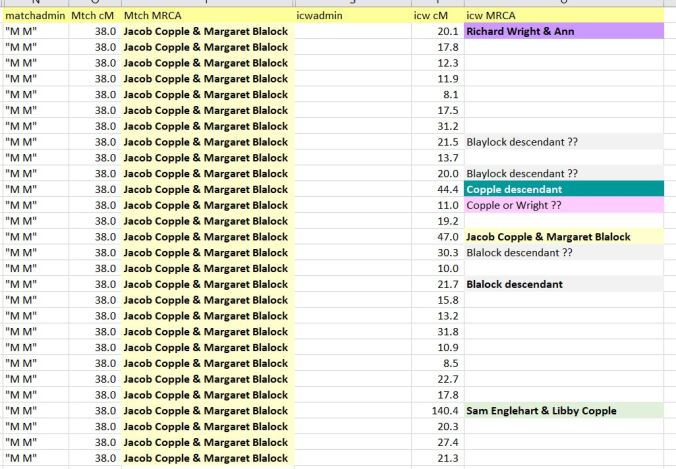
A different cousin of Mom’s who also descends from Jacob Copple & Margaret Blalock possibly inherited some of Margaret (Blalock) Copple’s DNA.  You can see that in the ICW MRCA column below, where some of the In-Common-With cousins (names are whited-out) appear to have Blalock / Blaylock lineage.  One of the cousins who shares DNA with both Mom and “M M” is fairly closely related to Mom; you can tell that by the amount of DNA shared (140.4 cM) and the MRCA = Sam Englehart and Libby Copple.  Libby Copple is the granddaughter of Jacob Copple & Margaret Blalock.
Cousin MM

All in all, this is just one more method of using color coding and Most Recent Common Ancestor information to figure out how your unknown matches may be related to you.  It’s not an absolute — it’s just a hint.  But it gives you something to work with.
1940 WPA Model of San Francisco — Digitized

If you have any interest at all in historical San Francisco, or if you — like me — have ancestors who lived there, this is worth checking out! 

https://www.davidrumsey.com/blog/2019/1/1/huge-san-francisco-1940-wooden-model-digitized

It can be viewed via Google Earth, Luna, and other tools — links available at the David Rumsey website above.  

Bay Area historian Gary Brechin has been a lead player in seeing that the model — originally used for city planning — be preserved and restored.


Margaret Colbert Dempsey: 52 Ancestors in 52 Weeks, #4

Nearly 5 years ago, Amy Johnson Crow came up with the idea of writing about a different ancestor each week (hence “52 Ancestors in 52 Weeks” — see here and here.) The premise was to put together a story in words, images or videos (or some combination) about a different ancestor, so the stories you had about your family were captured.  And if you were a hard-core researcher, so much the better — it was a way to organize the “stuff” you had gathered about a family member and get it into a coherent format, perhaps even seeing where you might lack info.

Which brings me to this “52 Ancestors” post.  I realized as I wrote up this summary about my paternal grandmother that I actually know very little about her!  I saw her only a few times in my life, first of all, and most of what I know about her is either from records (census, vitals) I discovered or stories my dad told me.  And then I have to balance that with the fact that all of her children and grandchildren are still alive… how much is “too much” for a blog post?

So, what do I know of my paternal grandmother’s life?  

Her name was Margaret Aileen Colbert and she not only lived her entire life in San Francisco, California, but she lived her entire life in the same house, just off Army Street (now known as Cesar Chavez Street).  She was the third of 4 children born to William Cornelius Colbert and Ellen (aka Eileen) Houlihan, both formerly of Athea, Co. Limerick, Ireland.

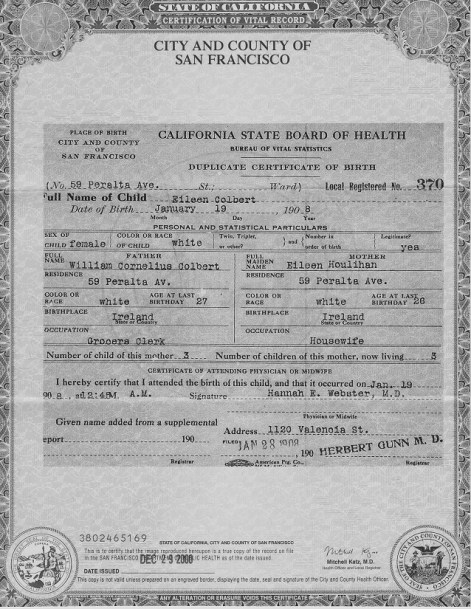
Margaret was born on 19 January 1908; the name on her birth certificate is given as Eileen.[1]  She had two older sisters: Honora Marie, born in May 1902 in San Francisco, and Anita, born in September 1903 in San Francisco.  Margaret’s younger brother William C. Colbert (aka “Babe”) was born in June 1910.

Nana_BirthCert

A copy of my grandmother’s birth certificate (see source citation below)

Margaret was just shy of 4 years old when her mother, Ellen (Houlihan) Colbert, died in San Francisco on 15 December 1911, of peritonitis due to a miscarriage.  Her father eventually remarried, circa 1922, to a woman named Harriet Maley, and in August 1923, Margaret’s half-sister Cornelia was born.

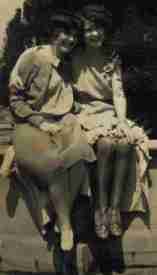
NanawithFriend500dpi

Margaret (left) with a friend, ca. 1930

Margaret’s father died in October 1931, when Margaret was 23 years old.  Then, 18 months later, she married Cassius Patrick Dempsey.  I do not know how they met.  They married in Hollister, San Benito County, California – and I do not know why they married there instead of their hometown of San Francisco.

Throughout their marriage they lived in the house that my grandmother’s Uncle Jack Colbert built, which was also the house she grew up in.  My father was their eldest child, of three children.  A sister followed 6 years later, and a brother 11 years after that.  All of them grew up in the same house too.

nanaGrandpa

My Nana and Grandpa, ca. 1933

IMAG4327 - Copy (2)

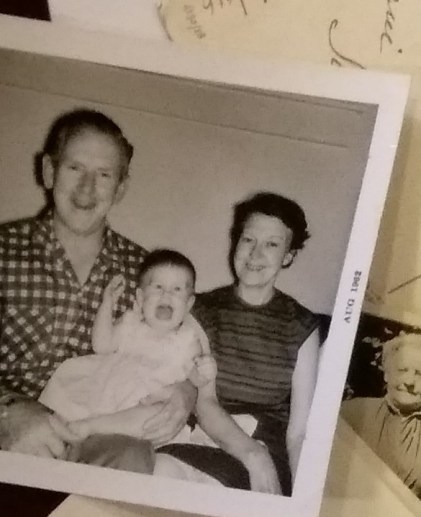
Me with my grandparents, 1962

I was 8 months old when my parents and I moved to Florida from California; we lived in Florida for 5 years, where my siblings were born.  Then we moved to the D/FW area.  My grandparents came out to Florida for Christmas in 1963, when I was a toddler.  That was the only time we ever saw them for Christmas, not that I remember it!  We do have home movies, and photographs, however.

NanaGrandpa63

My grandparents with my sister, Christmas 1963, in Florida

As for times I remember seeing my grandmother, I can count them on one hand, as we rarely made the long trip out to San Francisco, and they never visited us in Texas. 

The last time I ever saw my grandmother was when I visited my aunt (who is also my godmother) in San Jose over the Bicentennial Fourth of July.  My aunt and uncle were away for a short business trip, and my grandparents came down from San Francisco to stay with me and my younger cousins.

My grandmother died of heart failure on 30 October 1983, at the age of 75, when I was 22 years old.  She was buried at Holy Cross Cemetery in Colma, California.


[1] City and County of San Francisco, California, birth certificate local registered No. 370, Eileen [Margaret] Colbert (1908); Office of the County Clerk, San Francisco.

How Complete is my Tree?

Are you sure that the segment of DNA you share with your DNA match is due to your common 3rd great-grandparents Joe and Sally (Harper) Booth (that’s a fictional couple, by the way) — and not due to a common ancestor you may not yet have found?  How complete is your tree? 

Recently, Blaine Bettinger posted in Facebook’s Genetic Genealogy Tips and  Techniques group, about the completeness of your genealogical tree being critical to accuracy in ascertaining the correct common ancestor with your DNA matches.  He referenced a post by Amberly Beck (see here) in which she discusses the completeness (or lack thereof) of her maternal line.

Rather than looking at just my maternal line or just my paternal line, or even just looking at my whole tree at once, I decided to review my results by grandparent. 

how complete is my tree

I “found” 9 ancestors last year on my maternal side without using DNA at all! Instead, I used DanishFamilySearch.com, a site which has been transcribing Danish census records, and allowing registered users to post their family tree information on their site, and the newly online Danish census records (in Danish, of  course!) at familysearch.org 

So, yay!, that was success for my grandmother’s line.  I now know 4 more of my maternal grandmother’s 16 2nd great-grandparents, and 5 more of my grandmother’s 32 3rd-great grandparents.

As for my 3 other grandparents, there was no change in the past year.  Not surprising, because I spent time on the BU Certificate course for 15 weeks (during which I spent little time on my own genealogy), and I also spent some time continuing to validate with DNA matches my Copple line (which is also on my maternal grandmother’s tree). 

Meaning, as I build out collateral relative trees for my Copple ancestors and find I have — more accurately, my mother has — DNA matches with descendants of those collateral relatives (siblings and 1st cousins of my own ancestors), that is slowly strengthening the case that the DNA shared belongs to the Copple line and not some other unknown line.  (Well, until I am able to build further back; the shared DNA may actually relate to, say, the wife of my most distant Copple ancestor, and not to him.)

I’ve done nothing really on my maternal grandfather’s line — I know the Italian town he came from and his grandparents’ names.  I also know I would likely find records on their parents via the local Catholic church.  As it would likely require assistance from a researcher over in Italy or a trip to Italy myself, it just has not been a priority for me.  Perhaps someday.

Like my maternal grandfather, my paternal grandmother was a first-generation American.  Her uncle was Con Colbert who was executed for his role in the Easter Uprising in 1916.  Consequently, he is somewhat famous in the Republic of Ireland; therefore, some of his family history was researched by a professional genealogist for the centenary in 2016.  So, I have a bit more on her kin than on my maternal grandfather’s kin.  I’ve also been fortunate two years ago to find some of the baptismal and marriage records for her maternal line ancestors (also Irish) online — one such place is here.

I have a “brick wall” at my great-great grandfather Patrick Dempsey.  Per his obituary, he was “of King’s County”.  That’s now County Offaly, but that doesn’t mean he was born and baptized there.  It may just mean he was from there last before coming to America circa 1850 or so.  There are about a half-dozen potential Patrick Dempseys baptised in Co. Offaly when he was thought to be born (ca. 1830), but I have no oral history as to his family.   Maybe his parents and siblings died in the Famine?

This year, I’d like to find out more about my paternal grandfather’s maternal grandparents: Anderson and Ermine (Farnham? Farley?) Lamburth — Grandpa Dempsey’s one line that has reportedly been in the U.S. since at least 1800.  Of course, I’d also like to break the brick walls of my 3rd great-grandmother (aka my maternal grandmother’s great-grandma) Phoebe Harvey — or her mother-in-law Margaret (Blalock) Copple.  We’ll see.

How about you?  Do you have a particular line you’re thinking of researching next?   

My review of the B.U. Certificate in Genealogical Education course

This past fall I took the Boston University Certificate Program in Genealogical Research.  This is a 15-week online course (for continuing ed credits only — NOT undergrad academic credit) taught by experts and professionals in the field of genealogy. 

The program was updated and modified with my class (Fall 2018).  It now has 4 modules:  (1) Genealogical Methods (5 weeks); — taught by Allison Ryall
(2) Evidence Evaluation & Documentation (4 weeks); — taught by Julie Michutka
(3) Forensic Genealogy (4 weeks);  — taught by Melinde Lutz Bryne, CG, FASG
(4) Genealogy as a Profession (2 weeks). — taught by Angela Packer McGhie, CG

Assignments were due each week, and were graded.   In addition, you are expected to log on regularly, and to participate regularly in discussions that are part of each module.  You need a grade of C or better in each module, and a B- overall to attain your certificate.  (Note: this is just a certificate.  It does NOT mean you are a Certified Genealogist through the Board for Certification of Genealogists.)

Getting on to what I thought of the course, I loved it!  It was well worth the cost (close to $2,700 — but I got 10% off, as I am a member of National Genealogical Society).  I did NOT take the 7-week Essentials course suggested by BU in advance of this course, deciding instead to just take the plunge.  I definitely needed a minimum of 20 hours per week to get through this course — but some weeks were more intense (citations!) and other weeks were “easier” (for me, that was the first module).

While I can’t make specific remarks as to the course content, my suggestion is that you are best off in the first module if you are familiar with a wide variety of records and have a high-level understanding of how DNA matches play into genealogical research.with DNA.    The module on evidence and citations has a new textbook — Thomas Jones’ Mastering Genealogical Documentation.  You are taught the art of citing your sources by understanding the source itself and the information within it — so you won’t have to just refer to templates.

The Forensic Genealogy module includes a focus on Ethics, since ethics play a significant role in dealing with living people, as far as DNA research and (financial) inheritances are concerned.  Finally, the module of Professional Genealogy covers the basics of what it takes to be a professional genealogist, using the brand-new Professional Genealogy: Preparation, Practice & Standards (published in 2018).

I found all the instructors (and their assistants) to be extremely responsive to my fellow students and myself.  I also thought the interaction between the students via discussion forums to be extremely helpful, learning as much from my classmates as from the coursework itself.  (The interaction between classmates is limited to the group you’re in, however; there were enough enrolled students for Fall 2018 that the students were divided into 2 sections, and further divided into 5 subsections of roughly 25 students each.)

All in all, if you want to ramp up your genealogical research skills very fast, this is a great course in which to do it.  Be prepared for a “grind” — you’ll likely need those 20+ hours a week to work on the readings and assignments.  There were about 4 or 5 in my own subsection of roughly 25 students that apparently dropped out before the end of the first module.  Afterwards, if you earn your certificate, you can choose to join the alumni mailing group (which includes alumni from all the past classes, back to 2009); a Facebook group exists as well.


Charles Holst: 52 Ancestors in 52 Weeks, #3

  My great-granddad Charles Holst was one of 3 great-grandparents who were alive when I was born, and one of 2 I can actually remember, although the memory is fuzzy.  Grandpa Charlie (so-called by my aunt and uncles to differentiate him from the other grandparents) was born in Healdsburg, Sonoma County, California, on 18 October 1884, to Peter Holst, who was 37, and Caroline (Thomsen) Holst, who was 41.

Charlie had an older sister, Annie, born in 1875, an older sister Mary born in 1881.  Another son, named Peter, was stillborn a year before Charlie was born.  Reportedly, there was another brother, George, who was born in 1885, but I have found no records backing up his existence.

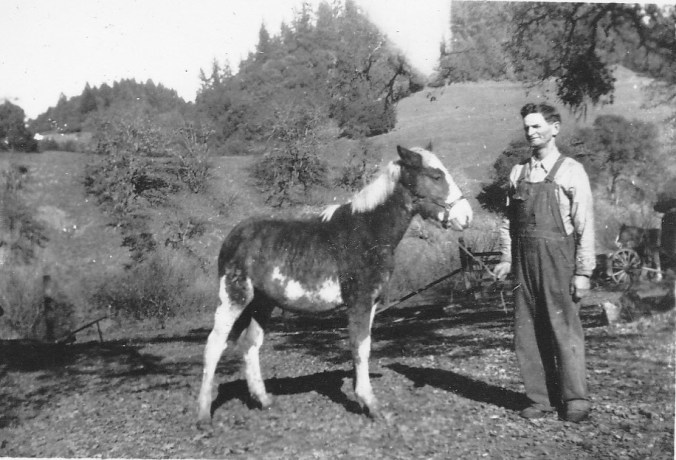
CharlieWithSpirit

Grandpa Charlie Holst with his horse named Spirit

The Holsts did not live in town, but instead on a ranch on Dry Creek Road, about 4 miles from Healdsburg proper, back in the hills.   Charlie’s father had a vineyard and a winery; the winery remained in production until Prohibition.

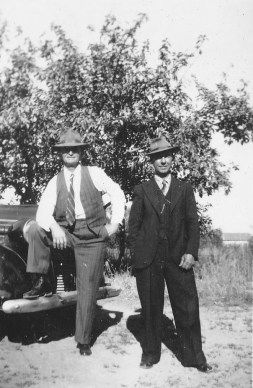
GrandpaCharlieandChasMoisan

Charlie Holst (left) with Charles Moisan, his wife’s brother-in-law

Grandpa Charlie’s parents were ethnically Danish, having both been born in the Duchy of Slesvig near Flensburg – an area which is now in Germany, and, in fact, became part of Bismarck’s Prussian Empire before they immigrated to the United States.

There is little I know about my great-grandfather.  I don’t know if he spoke Danish in addition to English.  I don’t know where he went to school, if he went to school at all – presumably there was a local school in the Healdsburg area.  I don’t know how he met the woman he would marry, Hazel Hannah Englehart, but possibly it was through her father, who reportedly built (or painted?) the Holst farm house, as he was a painter and carpenter. 

In any case, I had always been told that Charlie and Hazel married in January 1908, in Marin County, just south of Petaluma.  But when I ordered a copy of their marriage record, I discovered they married on 28 January 1909.  Their firstborn, a son named Charles (Junior) and called “Sonny”, was born just 6 months later on 2 August 1909. 

Their next child was my grandmother, Elizabeth, born in June 1914.  Another son, William, was born in 1921, and then a stillborn baby girl in 1928.

With Prohibition arriving in 1920, Charlie and his father ripped out all the vineyards they were cultivating, and starting growing plum trees.  Charlie’s father, a viticulturist, died before the repeal of Prohibition, as did his mother.  Charlie remained on the land, and made a living off the land until he died in 1968.

His children grew up and moved away, one serving in World War II and another having a family in Sonoma County, then divorcing his wife, and later moving to Oregon with his second wife.

HolstFamily1961

The Holsts in 1961.  L to R: Hazel (Englehart) Holst, Grace (Proden) Holst, Bill Holst (with dog), Charlie Holst, Charlie Holst Jr. (aka “Sonny”)

Their land off Dry Creek Road was where we visited when I was a four year old.  I remember the pink house they lived in, the sunshine, the hills which seemed to hug the house they were so close.  I remember going outside, and seeing my great-grandpa in the vegetable garden they had alongside the house, wearing denim overalls.   Although my mom tells me both my great-grandparents saw me as a baby, before we moved to Florida, that is my only memory of my great-granddad.  He died 2 years later in April 1968, and is buried in Oak Mound Cemetery in Healdsburg.

Genealogy Goals for 2019

I’ve never been one for rigid goal-setting, or resolutions. (Hey, my Myers-Briggs type is INFP — and we “P” people like to keep our options open!)

That being said, I’m in a fairly unstructured time in my life right now; a little structure will keep me focused. And the cherry on top is to post my plans here.

Here’s to an awesome 2019! Happy New Year!

Education and Development Comments
BU (online class) for Certificate of
Genealogical Research
completed Dec. 2018
IGHR (Athens, GA) week of July 21, 2019;
registration opens 2 Mar 2019
Texas Institute of Genealogical
Research 2019
week of June 9, 2019
Legacy Tree webinars focus on BCG-sponsored
Community and Colleagues  
join Assn of Professional
Genealogists
done!!
renew Indiana Genealogical Society membership done!!
renew NGS membership done — 2 year renewal
join Tx State Genealogical Society done!!
start attending DGS meetings and
DNA SIG meetings
attend meetings regularly in 2019
Writing (high-level)  
Evaluate: what do I know and
how do I know it?
for key (aka “brick wall”) ancestors
Formulate a research question and a research plan for each of the
“brick wall” ancestors (above)
 
Write up GPS proof summaries (or narratives) for each research question I’ve asked (and think I’ve answered) re: my ancestors’ lives  
DNA  
Continue mapping my
chromosomes
my favorite thing!
Copple (family line) project  
Ask other cousins if they will
consider testing
 
Long-Range  
submit my lineage to Sonoma
County Genealogical Society for a
certificate (if approved)
by the end of 2019
submit an article to NGSQ this is at least a year away
get my CG designation — or my AG designation this is at least a year away
enroll in and complete ProGen
study course
typically a 6 month wait list, after
you enroll. Offered 3 x a year.
   

Jacob Copple and Margaret (Blalock) Copple… Data Viz of their DNA-tested descendants

My Copple line was one of my “brick wall” lines, meaning I did not know the identities of  my great-great grandmother Libbie (Copple) Englehart’s parents, not to mention the fact I did not know for certain Libbie Englehart was even a Copple!  Thanks to DNA testing, it appears that the family oral history that Libbie was in fact a Copple appears to be true.

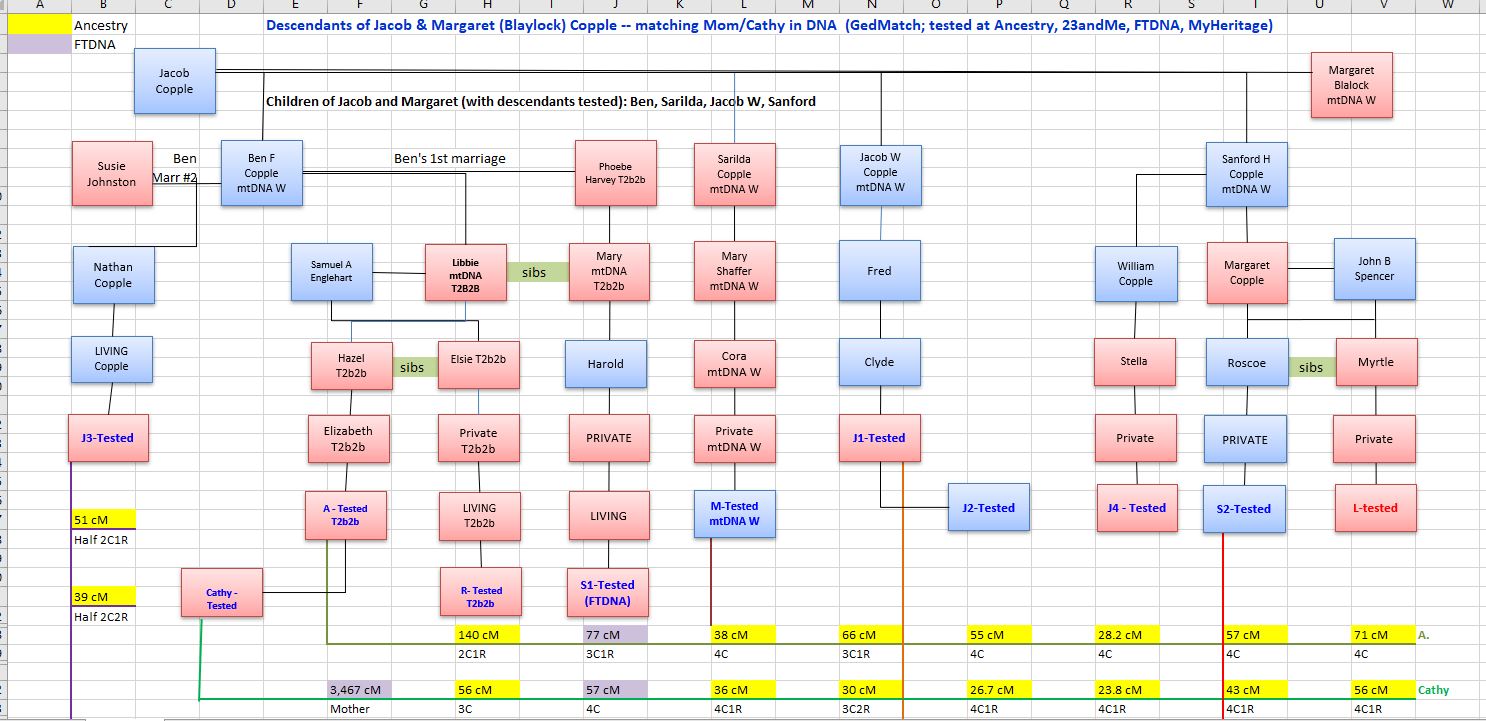
Below is a chart which shows Libby’s likely paternal grandparents Jacob and Margaret (Blalock) Copple, her father Ben and some of his siblings who have living descendants who have DNA-tested AND who match my mom.

I say “likely” paternal grandparents, meaning they are the best possible candidates for her grandparent

This particular data visualization is called the “McGuire Method” after Lauren McGuire, who developed it; her explanation of the chart can be found here.

McGuireMethod_Visual_CoppleFamily

What does this chart tell us?  It gives us an straightforward visualization of how the various descendants of Jacob and Margaret, my 4th great grandparents, relate to my mother and to me.

Jacob and Margaret are listed at the top, and are shown as the parents of Ben F Copple, Sarilda Copple, Jacob W Copple, and Sanford H Copple.  (Jacob and Margaret had 5 other children who reached adulthood, but those children either don’t have any descendants alive today, or don’t have descendants who have tested AND match my mom.)  Matching my mom is critical, if we are to use the DNA matches to validate the “paper trail” of documentation for the ancestors back to Jacob and Margaret.

Ben Franklin Copple is my 3rd great-grandfather, and the eldest son of Jacob and Margaret.  He was married twice — first to Phoebe Harvey, the mother of his 4 (possibly 5) daughters, and then to Susie, the mother of his 3 sons.  Libbie, my great-great grandma, and her sister Mary have descendants alive today who have gotten their DNA tested and match my mother and me.  In addition, a descendant of Ben’s son Nathan has tested and matches my mom.

Ben’s sister Sarilda has a descendant who has tested (called “M” on the chart), as does Ben’s brother Jacob Washington Copple.  Ben’s brother Sanford Howard Copple has numerous DNA-tested descendants, not all of whom are shown here.  Tested matches include descendants of Sanford’s daughter Margaret and Sanford’s son William. 

The two lines at the bottom of the chart are the key to the “McGuire Method” of visualization.  The first line shows the amount of DNA (in total centiMorgans) that my mom “A” shares with the tested cousin(s).   What is a centiMorgan?  The most simplistic explanation is that it’s a logical — not physical — unit of length of an unbroken sequence of the bases (adenine (A), thymine (T), cytosine (C), and guanine (G)). 

Your longest unbroken string of base sequences for each of your chromosomes would be shared with your mom and your dad — that is, from one end of each chromosome to the other.  More distant relatives, like 3rd cousins, may share only one or two segments of DNA — or none at all.   (For more detail on centiMorgans, see here, here and here.)

Amounts of shared DNA highlighted in yellow on this chart are based on the AncestryDNA test; amounts highlighted in purple are based on FamilyTreeDNA’s test.  Below the centiMorgan (cM) amounts is the relationship (e.g., “4C” = 4th cousin, “2C1R” = 2nd cousin one generation removed).

Below my mother’s shared DNA amounts is my own shared amounts with those same cousins.  With certain matches, I inherited less than half of mom’s shared DNA; in other cases, I inherited essentially all of it.

Since I first created this chart, a descendant of another of Ben Copple’s sons — brother to Nathan shown on the chart — has had their DNA tested and shares DNA with my mom.  In addition, at least one descendant of a third child of Ben’s brother Sanford has tested, and they, too, are a match.   As additional descendants test — and match — my mother, this strengthens the case I am making (based on the paper trail) that this is Libbie (Copple) Englehart’s family — her dad, her paternal aunts and uncles, and her paternal grandparents.  And hence my mother’s family and my own as well.


James Diamantini: 52 Ancestors in 52 Weeks, #2

My granddad was the youngest of 3 sons, born to Giuseppe Diamantini and Maria (Bolognesi) Diamantini in Sonoma County, California, on 16 October 1914.   My mother — his daughter – always said he was born in Calistoga, which is in Napa County, or in Mark West Springs, which is in Sonoma County.   The California Birth Index lists the county as Sonoma; I still (!) need to order the actual certificate, so I guess we’ll see.   

The U.S., Social Security Applications and Claims Index, 1936 – 2007, database online at Ancestry.com lists Grandpa’s birth place as Santa Rosa South, and his name as James Diamantine.  He made his application in 1942, and at this time, he and his brothers were Anglicizing their name from Diamantini to Diamantine.

I knew my grandfather’s name to be James Eugene, but I do not know the name he was born with.   According to the California Birth Index, a first name for my grandfather is not listed on the birth certificate.  However, on the 1920 census, his name is given as Trenton (which doesn’t sound very Italian to me, nor is it a family name that I know of.) 

1920 census, Sonoma County, California (click to zoom in)

My granddad’s two older brothers were Gaspare Antonio (aka “Gilbert”), born in 1904, in Italy, and Francis Angelo (known as Frank), born in January 1909, in Healdsburg, Sonoma, California.   Although the State of California required registering births as of July 1, 1905, there is no certificate for Frank.  My great-grandparents,  just recently in the U.S. – they arrived in 1908 – likely did not know “the routine”.     However, I do have a copy of Frank’s Social Security Application, on which he states his date and place of birth.

 I have not been able to find the family on the 1930 census (yet), but presumably they were living near Healdsburg, as my grandfather attended Healdsburg High as a member of the Class of 1934.   

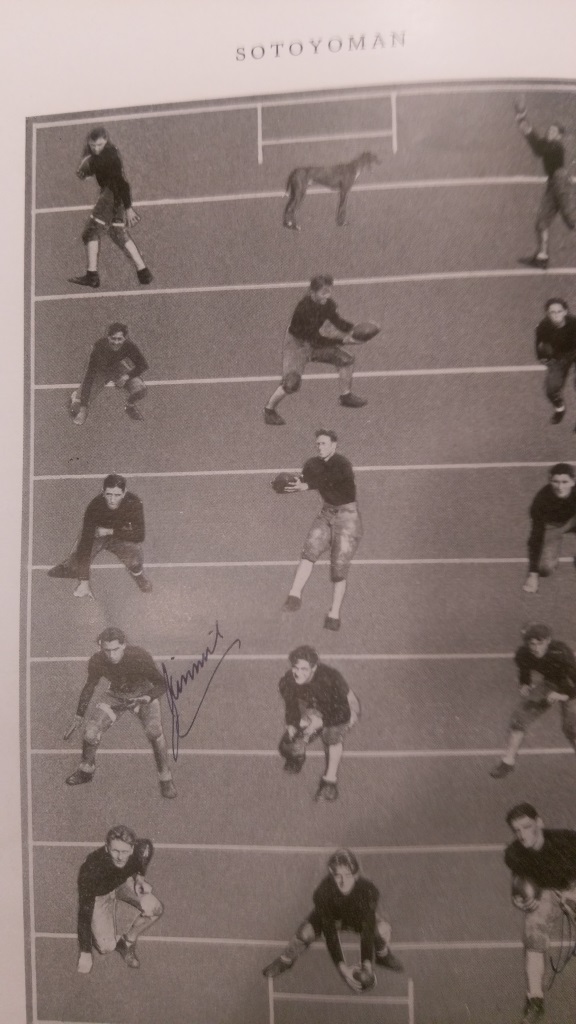
While in high school, my granddad played football, and also met my grandmother, Elizabeth.

my grandparents

James and Elizabeth married on 22 November 1934, in Healdsburg, and then went to live in Tracy, California, where they worked at the service station owned by James’ older brother Gil.  My mother was born within two years of their marriage, and life was good, until Elizabeth died in 1940, after giving birth to a stillborn daughter.

my grandparents’ marriage certificate

After my grandmother’s death, my grandfather came back to the Hayward area, where his parents were living.  They fixed him up with an Italian woman his age who lived down the street from them, and the two were married in May 1941.  James and Jean (“Nonna”) had 6 children in the next 10 years.  

Grandpa worked in the shipping yards during World War II, and later worked with his brothers, who owned a lumberyard.   He was also a beekeeper, and, in the early 1970s, he and Nonna moved out to Manteca, California, where they had a ranch, and where he cultivated a vineyard.

But Grandpa began to suffer from Parkinson’s during the late 1970s, and so he and Jean decided to sell the Manteca property, and move back to Hayward.  I only saw my granddad a few times when I was growing up, and didn’t go out to California to see my mom’s relatives at all for a period from about the age of 10 to the age of 25.  

Grandpa’s Parkinson’s got worse over the years, to where he could barely walk and talk.   He died in May 1995, at the age of 80, in Hayward, and is buried at Holy Sepulchre Cemetery in Hayward, near his parents and his brothers.

Sources:

Social Security Administration, “U.S., Social Security Applications and Claims Index, 1936-2007,” database,
Ancestry.com (https://search.ancestry.com/search/db.aspx?dbid=60901 : accessed 11 January 2016), entry
for James Diamantine, 1995, SS no. 567-24-6586.

Social Security Administration, “U.S., Social Security Death Index, 1935-2014,” database, Ancestry.com (https://search.ancestry.com/search/db.aspx?dbid=3693 : accessed 11 January 2016), entry for James Diamantine, 1995, SS no. 567-24-6586.

1920 U.S. census, Sonoma County, California, population schedule, Enumeration District 152, Santa Rosa, sheet 4, page 12B, dwelling 83, family 84, Joe Diamantini household; digital image, Ancestry.com (https://search.ancestry.com/search/db.aspx?dbid=6742 : accessed 20 December 2018); citing National Archives and Records Administration (NARA) microfilm publication T625, roll 151.

“California Birth Index, 1905-1995,” database, FamilySearch (https://familysearch.org/ark:/61903/1:1:VGQF-SHV : accessed 7 July 2016), Diamantini, 16 Oct 1914; citing Sonoma, California, United States, Department of Health Services, Vital Statistics Department, Sacramento.

Aunt Nellie’s Nutmeg Coffee Cake — great for the holidays!

My mother received this recipe as part of a wedding gift from my father’s Aunt Marie, who, before she died, told me it was not her recipe but rather her Aunt Nellie’s recipe (my great-grand aunt). So it’s been in the family for a number of generations, and we love it. Typically, it’s all eaten in one day. (Which is just as well; it doesn’t taste as good reheated in the microwave.)

** Since this is a genealogy blog, alas, I can’t help but note that it turns out my grand-aunt Marie did not have an or a grand-aunt named Ellen (aka Nellie)!  She did have a sister-in-law named Nellie, and at least one cousin named Nellie.  **

So, here’s the recipe: 

2½  cups cake flour ¾ cup granulated white sugar
1 cup light brown sugar 1 teaspoon nutmeg, freshly ground
1 teaspoon salt ¾ cup vegetable oil
1 egg 1 teaspoon baking powder
1 teaspoon baking soda 1 teaspoon vanilla extract
1 cup buttermilk

Preheat oven to 375 degrees.  Butter a 10-cup Bundt or 9 x 2 inch square pan.  Dust the pan with flour, and shake out any excess flour.

Sift together the flour, white sugar, brown sugar, nutmeg and salt.

Combine the sifted ingredients and cooking oil in the bowl of a standing mixer fitted with paddle attachment or use a large mixing bowl and a handheld electric mixer.  Cream the mixture at medium-low speed until it is the texture of fine crumbs.

Remove 1 scant cup of the crumb mixture and set aside.

To the remaining mixture, add the egg, baking soda, baking powder, and vanilla extract.  Beat 30 seconds.  Reduce the mixer to low speed.  Add the buttermilk, mixing only for a few seconds just until blended.

Pour the batter into prepared pan and spread the top evenly with a spatula.  Sprinkle the crumb mixture evenly on the top of the cake.  Place the cake on the lower oven rack and bake for 35 minutes, or until a cake tester or toothpick inserted in the center comes out clean.

Remove the cake from the oven, place on a wire rack, and cool in the pan for at least 20 minutes.

Note:  In a pinch, you can use 1 cup of milk (soured with 1 tablespoon white vinegar) if you don’t have buttermilk, but buttermilk is preferable in creating a velvety texture for the cake. And fresh ground nutmeg beats the canned or bottled stuff, hands down.

For the streusel mixture, I have found that a Kitchen Aid stand mixer is too powerful, even at the lowest speed; you won’t get the fine crumbs you need. A hand-held mixer or a fork is preferable.