My Copple line was one of my “brick wall” lines, meaning I did not know the identities of my great-great grandmother Libbie (Copple) Englehart’s parents, not to mention the fact I did not know for certain Libbie Englehart was even a Copple! Thanks to DNA testing, it appears that the family oral history that Libbie was in fact a Copple appears to be true.
Below is a chart which shows Libby’s likely paternal grandparents Jacob and Margaret (Blalock) Copple, her father Ben and some of his siblings who have living descendants who have DNA-tested AND who match my mom.
I say “likely” paternal grandparents, meaning they are the best possible candidates for her grandparent
This particular data visualization is called the “McGuire Method” after Lauren McGuire, who developed it; her explanation of the chart can be found here.
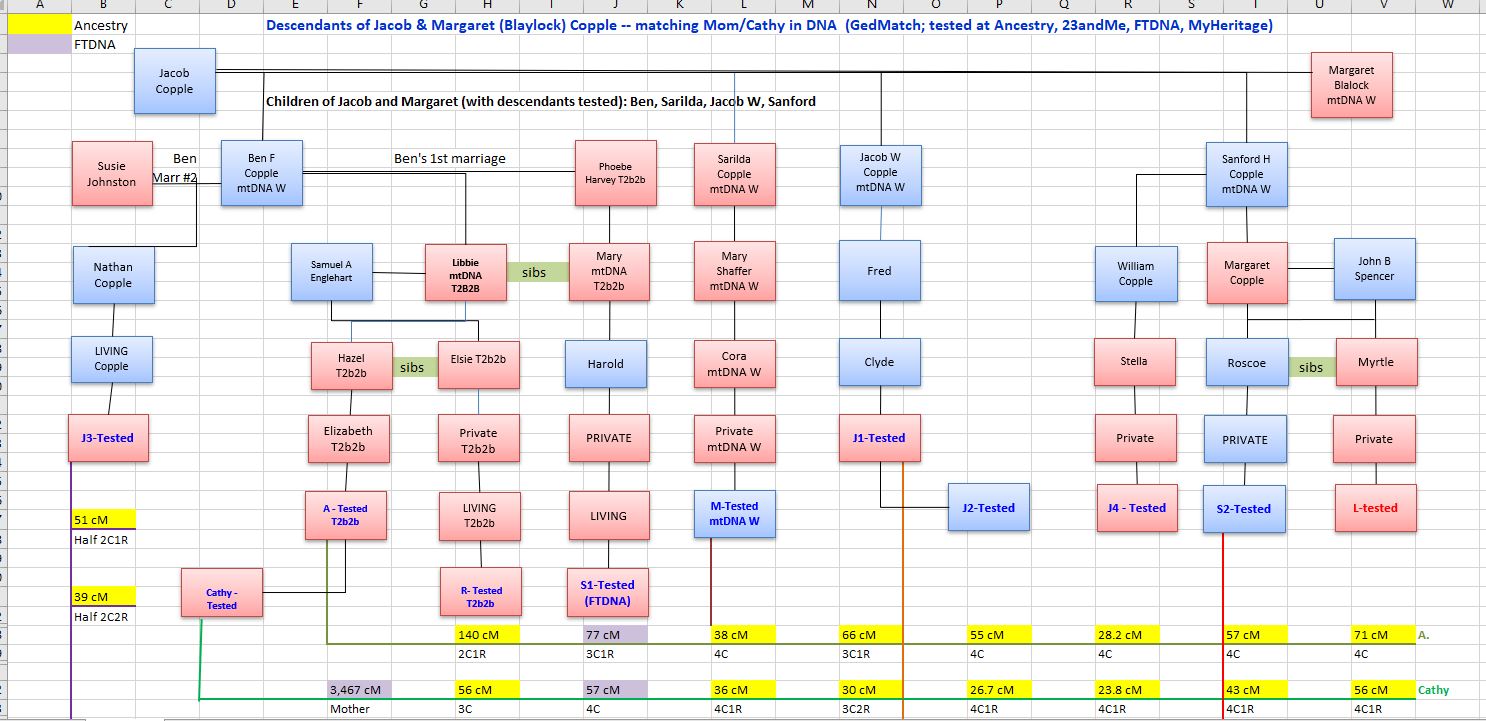
What does this chart tell us? It gives us an straightforward visualization of how the various descendants of Jacob and Margaret, my 4th great grandparents, relate to my mother and to me.
Jacob and Margaret are listed at the top, and are shown as the parents of Ben F Copple, Sarilda Copple, Jacob W Copple, and Sanford H Copple. (Jacob and Margaret had 5 other children who reached adulthood, but those children either don’t have any descendants alive today, or don’t have descendants who have tested AND match my mom.) Matching my mom is critical, if we are to use the DNA matches to validate the “paper trail” of documentation for the ancestors back to Jacob and Margaret.
Ben Franklin Copple is my 3rd great-grandfather, and the eldest son of Jacob and Margaret. He was married twice — first to Phoebe Harvey, the mother of his 4 (possibly 5) daughters, and then to Susie, the mother of his 3 sons. Libbie, my great-great grandma, and her sister Mary have descendants alive today who have gotten their DNA tested and match my mother and me. In addition, a descendant of Ben’s son Nathan has tested and matches my mom.
Ben’s sister Sarilda has a descendant who has tested (called “M” on the chart), as does Ben’s brother Jacob Washington Copple. Ben’s brother Sanford Howard Copple has numerous DNA-tested descendants, not all of whom are shown here. Tested matches include descendants of Sanford’s daughter Margaret and Sanford’s son William.
The two lines at the bottom of the chart are the key to the “McGuire Method” of visualization. The first line shows the amount of DNA (in total centiMorgans) that my mom “A” shares with the tested cousin(s). What is a centiMorgan? The most simplistic explanation is that it’s a logical — not physical — unit of length of an unbroken sequence of the bases (adenine (A), thymine (T), cytosine (C), and guanine (G)).
Your longest unbroken string of base sequences for each of your chromosomes would be shared with your mom and your dad — that is, from one end of each chromosome to the other. More distant relatives, like 3rd cousins, may share only one or two segments of DNA — or none at all. (For more detail on centiMorgans, see here, here and here.)
Amounts of shared DNA highlighted in yellow on this chart are based on the AncestryDNA test; amounts highlighted in purple are based on FamilyTreeDNA’s test. Below the centiMorgan (cM) amounts is the relationship (e.g., “4C” = 4th cousin, “2C1R” = 2nd cousin one generation removed).
Below my mother’s shared DNA amounts is my own shared amounts with those same cousins. With certain matches, I inherited less than half of mom’s shared DNA; in other cases, I inherited essentially all of it.
Since I first created this chart, a descendant of another of Ben Copple’s sons — brother to Nathan shown on the chart — has had their DNA tested and shares DNA with my mom. In addition, at least one descendant of a third child of Ben’s brother Sanford has tested, and they, too, are a match. As additional descendants test — and match — my mother, this strengthens the case I am making (based on the paper trail) that this is Libbie (Copple) Englehart’s family — her dad, her paternal aunts and uncles, and her paternal grandparents. And hence my mother’s family and my own as well.
 Genes and Roots