The Case of the Kentucky Tax Lists: When AI Meets 19th Century Records

Or: What happens when a genealogist turns artificial intelligence loose on 200-year-old tax data

Every family historian knows the thrill of discovery—that moment when scattered pieces of evidence suddenly click into place, revealing relationships that were hidden in plain sight. Recently, I decided to enlist some high-tech help in solving a genealogical puzzle that had been nagging at me: the Wright family’s settlement patterns in Wayne County, Kentucky, from 1802 to 1813.

My 6th great-grandfather Amos Wright lived in Wayne County during those crucial early years before heading off to Washington County, Indiana around 1808. But Amos wasn’t alone—the tax records showed multiple Wrights scattered across the county’s creeks and hollers. Were they related? How were they connected? And could artificial intelligence help me see patterns I’d missed?

Inspired by a podcast episode about using AI to analyze tax data, I decided to conduct my own experiment. What followed was part genealogical investigation, part technology test drive, and entirely fascinating.

Setting the Stage: Garbage In, Garbage Out

Before I could turn my AI assistants loose on the data, I had to confront every genealogist’s nemesis: inconsistent 19th-century spelling. Standard genealogical practice in transcribing is to write it exactly as it is in the document you are viewing. However, the minefield of variants—”Right” versus “Wright,” “Amos” versus “Amus”— if left as is in my spreadsheet— would likely confuse any algorithm into thinking we were dealing with entirely different people.

So, cleanup — on a copy of my originally transcription — was my first task. Each variant had to be standardized, each waterway name corrected. After all, what good is artificial intelligence if you’re feeding it artificial confusion?

Round One: ChatGPT Takes the Stand

Armed with my cleaned dataset, I posed my first question to ChatGPT: “Taking into consideration the columns ‘Person Chargeable w/ Tax’, ‘Water Course’, ‘Name Entered’ and ‘Name Surveyed’, suggest possible relationships between the various taxpayers.”

ChatGPT approached the problem like a seasoned detective, immediately zeroing in on geographic clustering:

The Beaver Creek Connection: The AI noted that Amos Wright, Evan Wright, and Philip Copple all had land along Beaver Creek, suggesting they were neighbors—or possibly kin. This observation proved remarkably astute, as I knew from my research that Amos and Evan were indeed brothers, and Philip Copple had married one of Amos’s daughters.

The Henry Biggs Mystery: ChatGPT flagged Henry Biggs as a recurring figure whose name appeared in both the “Name Entered” and “Name Surveyed” columns for multiple Wright properties. The AI theorized that Biggs was either a surveyor or someone whose land abutted Wright holdings—a hypothesis I hadn’t fully explored.

The Surveyor Theory: Most intriguingly, ChatGPT suggested that Amos Wright himself might have been active as a surveyor, noting his name appeared in surveying columns. This painted a picture of Amos as a community leader—a “patriarch,” as the AI put it.

But here’s where it got interesting: ChatGPT completely ignored William Wright, Elijah Wright, John Wright, and Isaac Wright in its initial analysis. When an AI overlooks data, it’s worth asking why.

The Plot Thickens: New Evidence Emerges

Suspecting I’d missed some entries, I went back to the original tax records. Sure enough, I’d overlooked Samuel Wright, Moses Wright, and Jesse Wright. After adding these men to my dataset, I decided to test something: would ChatGPT give me the same answers with the expanded data?

The answer was no—and that’s when this investigation took an unexpected turn.

Day Two: The Same Question, Different Answers

Using identical prompts with the revised dataset, ChatGPT offered notably different conclusions. Instead of focusing solely on Beaver Creek clustering, it now suggested:

  • Chronological Settlement Patterns: William Wright at Elks Spring, Amos at Beaver Creek, Jesse at Meadow Creek might represent an “order of settlement”
  • Land Transfer Networks: The appearance of names like Stacter and Biggs as “predecessor patentees” suggested the Wrights were systematically acquiring nearby tracts
  • Three Wright Lines: The AI now theorized three different Wright family lines establishing themselves simultaneously in Wayne County around 1802

This inconsistency raised a red flag. If AI is supposed to be deterministic, why were my answers changing? It reminded me that these tools, powerful as they are, aren’t infallible oracles—they’re sophisticated pattern-matching systems that can be influenced by data variations.

Revealing the Facts: Guided Analysis

At this point, I decided to level the playing field. I fed both ChatGPT and Claude AI the facts I’d uncovered through traditional research:

  • William, Evan, and Amos Wright were brothers
  • Philip Copple was Amos Wright’s son-in-law
  • There were two different John Wrights in the records
  • Elks Spring was a tributary of Beaver Creek
  • Biggs and Stacter might have been county surveyors

With these revelations, both AIs refined their analyses significantly. ChatGPT now correctly identified the geographic relationships (William and Amos as neighbors along the same creek system) and properly distinguished between professional relationships (surveyors) and family ties.

Claude AI Enters the Investigation

When I presented the same data to Claude AI, it took a somewhat different approach. Where ChatGPT had been expansive in its theorizing, Claude was more cautious—but it also made some notable errors.

Claude correctly identified the surveyor relationships and community connections, but missed the marriage connection between Philip Copple and the Wright family entirely. More concerning, it made what appeared to be a complete fabrication, claiming that “Jesse’s land is often ‘Name Entered’ or ‘Name Surveyed’ under William Wright’s entries”—something that simply wasn’t in the data.

This reminded me of a crucial lesson: AI can hallucinate connections that don’t exist, just as easily as it can miss ones that do.

The Smoking Gun: Details Only Humans Notice

One detail that only Claude mentioned caught my attention: Evan Wright consistently appeared in the “Blacks” column of the tax records, indicating he was a slaveholder. This wasn’t a relationship pattern—it was a social and economic marker that added crucial context to understanding the Wright family’s standing in Wayne County society.

What the Evidence Reveals

After running this comparative analysis, several patterns emerged that neither AI fully captured on its own:

Geographic Clustering: The Wright brothers clearly settled along connected waterways, with William at Elks Spring (a tributary of Beaver Creek) and Amos directly on Beaver Creek itself. This wasn’t coincidence—it was family strategy.

Professional Networks: The recurring appearance of Henry Biggs and Samuel Stacter in survey records likely reflects their roles as county officials rather than family relationships, though neighboring land ownership remains possible.

Generational Succession: The appearance of younger Wrights (Elijah in 1809, likely William’s son coming of age) demonstrates how tax records can reveal family demographics over time.

Separate Wright Lines: Jesse Wright’s consistent association with Meadow Creek and different survey patterns suggest he represented a distinct Wright family line—not necessarily related to Amos, William, and Evan despite sharing the surname.

The Verdict: AI as Research Assistant, Not Replacement

So what’s the takeaway from this technological experiment? AI proved remarkably useful for pattern recognition and hypothesis generation, but it also demonstrated significant limitations:

Strengths:

  • Excellent at identifying geographic and temporal clustering
  • Good at spotting recurring names and potential professional relationships
  • Capable of generating testable hypotheses about family structures

Weaknesses:

  • Inconsistent results with identical queries
  • Tendency to hallucinate connections not present in the data
  • Missed obvious relationship indicators (like known family connections)
  • Limited ability to distinguish between different types of relationships

The Human Element

Perhaps most importantly, this experiment reinforced why traditional genealogical research remains irreplaceable. The AI’s most accurate insights came only after I provided the human context—the family relationships I’d painstakingly documented through other sources.

Without that foundation, the AI was essentially reading tea leaves, finding patterns that may or may not reflect historical reality. With it, the technology became a powerful tool for exploring implications and connections I might have missed.

A Final Twist: The Copyright Question

One unexpected discovery emerged during this process: ChatGPT had apparently trained on some of my own blog posts, citing them as sources without my explicit permission. This raises intriguing questions about how AI systems acquire their knowledge—and reminds us that the information we freely share online may someday be reflected back to us in unexpected ways.

Closing the Case

The Wright family tax records of Wayne County, Kentucky tell a story of strategic settlement, family networks, and community building in the early American frontier. AI helped illuminate some of these patterns, but only human knowledge could properly interpret them.

For fellow genealogists considering similar experiments, my advice is this: use AI as you would any other research tool—with curiosity, skepticism, and the understanding that technology amplifies both our insights and our errors. The algorithms can spot patterns we miss, but they can’t replace the detective work, critical thinking, and contextual knowledge that make family history come alive.

After all, behind every tax record entry was a real person making real decisions about where to live, whom to marry, and how to build a life on the Kentucky frontier. No algorithm, however sophisticated, can fully capture that human story—but it might just help us see new chapters we hadn’t noticed before.

What patterns have you discovered in your own family’s records? Have you experimented with AI in your genealogical research? I’d love to hear about your experiences—and any Wright or Copple connections you might have uncovered along the way.

“AI Detective: Wayne County Tax Records,” Claude Sonnet 4, chat initiated by user Cathy Dempsey, Claude (https://claude.ai/chat/818f967f-d918-42f2-9293-873902f1cdf9 : accessed 28 August 2025)

G is for Guernsey County, Ohio

Back to my “Family History from A to Z” series…

I’ve picked up my genealogy work after several years of sidelining it. I signed up for a SLIG 2025 (virtual) class on advanced methodology to be held in January, a second SLIG virtual class on writing to take place in February and March (weekly). Finally, most recently the Research Like a Pro e-course taught by the ladies at FamilyLocket.com after I first read their books at the library, and then bought the Kindle versions.

For the e-course, I am writing up research on my finding the father of my 3G grandmother Hannah (Hill) Englehart. I actually did the research years ago, came up with a father candidate, and that candidate (Andrew Hill) was ultimately validated via DNA. But I have only a research log, some scraps of notes, and skeletal citations, so I decided this would be a good project for this class to get me back in gear.

And one of the steps I’ve taken in the e-course — and part of the Research Like a Pro process — is to create a locality guide for my main research area. Because my 3G grandmother Hannah (Hill) Englehart was married in Guernsey County, Ohio (and apparently grew up there), I created a locality guide for that county. Additions to it are ongoing but what I have is below.

Guernsey County, Ohio Locality Guide

Prepared for Identifying the father of Hannah Hill Research Project by Cathy Dempsey; created 18 October 2024 (from a template created by familylocket.com

Background

Quick Facts

  • County Seat: Cambridge
  • Named for the Isle of Guernsey in English Channel, as many original settlers came from Guernsey
  • Formed 10 March 1810, from portions of Muskingum and Belmont counties
  • Ohio became a state on March 1, 1803, and was formed from part of the Northwest Territory (which was formed in 1787).
  • Countywide marriage and court records began in 1810, birth and death in 1867
  • Statewide birth and death records began in 1908
  • Ohio is a State Land State

Online Research Guides

Guernsey County, Ohio  – Family Search wiki

Guernsey County, Ohio: Family History & Genealogy, Census, Birth, Marriage, Death Vital Records & More – Linkpendium

Guernsey County Genealogy Guide – Random Acts of Genealogical Kindness

Guernsey_County,_Ohio (Wikipedia)  – Wikipedia

Archive Grid  ArchiveGrid is a collection of millions of archival material descriptions, including MARC records from WorldCat and finding aids harvested from the web.  

Geography and Maps

In 1851, lost Buffalo, Beaver, Olive and Seneca townships in the creation of Noble County to the south of Guernsey.

Neighboring Counties:  Coshocton (northwest), Tuscarawas (north), Harrison (northeast), Belmont (east), Noble (south), Muskingum (southwest/west)

Maps and Gazetteers:

Timeline of Major Events

Timeline of the area including major government changes and events

Ohio: Individual County Chronologies Newberry Library, 2007

The Historical Development of Guernsey County and Its Townships  Anderson, Scott C. R.  (USGennet.org)

History

History of settlement, links to history articles and books about the locality, major periods, military engagements,

Migration Routes

Describe main migration routes through your locality and link to maps and articles about the subject.

Principal Routes of Trade and Migration, 1840–1850  (accessed 18 October 2024)

https://www.familysearch.org/en/wiki/United_States_Internal_Migration (access 18 Oct 2024)

Law and Government

Old books that have been digitized (via Google Books, Internet Archive, Geneanet, etc.) that contain the laws and statues of the particular locality that you are researching; blog posts and articles about laws in your locality (check out the Legal Genealogist blog and library websites)

Libraries and Archives

Guernsey County
Administration Building
801 E. Wheeling Avenue
Cambridge, Ohio 43725-2335
Phone: 740-432-9230
Guernsey County Website

Guernsey County District Public Library 63500 Byesville Road
Cambridge, OH 43725

The Digital Archives of Guernsey Memorial Library

The Samuel D. Isaly Library  Bellville, Ohio [library of the OGS]

Ohio History Connection Archives & Library  Columbus, Ohio  [formerly Ohio Historical Society]

National Archives at Chicago    Serves Illinois, Indiana, Michigan, Minnesota, Ohio, and Wisconsin. 

Ohio State Archives

Genealogical Societies and Publications

Guernsey County Genealogical Society [Guernsey County Chapter of OGS]  Cambridge, Ohio

Ohio Genealogical Society   Bellville, Ohio

Record Loss

No known record loss.

Local History

Guernsey County History Museum Flickr Account: People  Guernsey County Historical Society

Guernsey County History Museum Flickr Account: Township Plats  Guernsey County Historical Society  (The images in this album are derived from a plat scan made available to the public by the Library of Congress)

Sarchet, Cyrus P.B.; History of Guernsey County, Ohio, (Indianapolis, Indiana: B.F. Bowen and Co., 1911). Volume 1 online at FamilySearch Digital LibraryInternet Archive; Volume 2 online at FamilySearch Digital LibraryGoogle Books

Wolfe, William G.; Stories of Guernsey County, Ohio: History of an Average Ohio County, (Cambridge, Ohio: W.G. Wolfe, 1943). Online at FamilySearch Digital Library

Reference Books

Additional books pertaining to research in this locality.

Record Collections

General Collections

Ancestry.com, FamilySearch.org, MyHeritage.com, FindMyPast.com etc. catalog titles about the locality

United States Record Finder on familysearch.org

Bible Records and Compiled Genealogies

Links to websites that have Bible records for the locality

Ohio Bible Records on familysearch.org

Cemetery Records

Links to cemetery records in the locality

Census Records and Substitutes

Links to different types of censuses: federal, state, town, colonial, territorial, census substitutes, etc.

United States Federal Census 1820 > Ohio > Guernsey

United States Federal Census 1830

Church Records

List the various denominations and where their records are kept.

Ohio Church Records — a general information page on familysearch.org

Determining the Church Your Ancestor Attended familysearch.org

Ohio, Church and Civil Births and Baptisms, 1765-1947  familysearch.org

Court Records

Links to court record collections and descriptions of what they contain

Guernsey County Clerk of Courts: Location of Court Records (Case Files, Docket appearances, etc.) PDF  — Guernsey County Clerk of Courts

Guernsey County Clerk of Courts homepage

Court records, 1810-1862 [Court of Common Pleas]  familysearch.org

Court records, 1811-1856 [Ohio Supreme Court]  familysearch.org

Ohio, Guernsey County, Common Pleas Journal and appearance dockets  [1829 – 1990] familysearch.org

Ohio, Guernsey County, Common Pleas Journal and appearance dockets, 1810-1938 at familysearch.org

Ethnic Records

List the various ethnic groups in the locality and what unique record collections are available about them.

Immigration and Naturalization

Describe immigration in the locality and link to the associated record collections.

Land Records

Land records were kept as of 1802

Ohio Land and Property  familysearch.org wiki

The Official Ohio Lands Book (pdf format)  Knepper, George W., pub. By Ohio State Auditor Office, 2002

The Northwest and the Ordinances, 1783-1858  Library of Congress (summarized history)

Land Ordinance of 1785  wikipedia.org

Northwest Ordinance of 1787  wikipedia.org

Guernsey County Recorder  – has land records

Deed records, 1810-1901; index, 1802-1968   familysearch.org

Guernsey County Township Maps  

Legislative Records

Link to collections about legislative records, if applicable, i.e. Virginia’s legislative petitions.

Military Records

Colonial, militia, war, regimental histories, etc.

Newspapers and Directories

Link to websites which contain digitized newspapers for your locality or how to find them if they aren’t digitized.

UF Digital Collections: Guernsey County (Ohio) Newspapers [early 20th century only]

The Digital Archives of Guernsey Memorial Library   OCR text is poor, with no option to fix as with CDNC. However, clicking on the link available allows you to see a digitized mage of the page.

Ohio Newspaper Archives 1795-2021  genealogybank.com

Probate Records

Link to record collections about will administration, probate, etc.

Probate records began to be kept as of 1812.

Ohio Probate Records, 1789-1996  familysearch.org    “Probate records and estate files from county courthouses in Ohio. The content and time period varies by county.”

Administration and execution dockets, 1812-1992  Probate Court (Guernsey County) on familysearch.org

Vital Records (Birth, Marriage, Death)

List the start of registration for birth, marriage, and death records. List any Gretna greens.

Birth and death records kept at the county-level as of 1867.  Marriage records kept as of 1810.

Birth records v. 1-3, 1867-1909, 1941-1963 Guernsey County Probate Judge; familysearch.org

Marriage records, 1810-1951, 1992-1997; index to marriages, ca. 1810-1930 Guernsey County Probate Court; familysearch.org

Death records, 1867-1960 Guernsey County Probate Judge; familysearch.org

Tax Records

Link to tax record collections, personal property tax, land tax, etc.

Guernsey County, OH Tax Duplicates 1816-1832  Guernsey County, Ohio Auditor. Familysearch.org

1950 U.S. Census — Volunteer Project at Familysearch.org

Today I spent about 2 hours validating that the computer-generated indexes already created — and not all 50 states are yet done — were accurate. I worked on Indiana, Oregon, and Arizona. Technology has come such a long way in the past 10 years; I am amazed at how accurate the indexed data appears already.

You can validate names in a given state, or, if the name validation is complete, you can validate family groups. And the cool thing is you can select names, so for the family groups I was validating (in Oregon and Arizona) I specifically searched for COPPLE households. (And recognized some of the names I already have in my COPPLE tree on Ancestry.com)

There is plenty to do for anyone interested, and you can do just a little bit or do a lot — any amount helps get the indexing done faster.

Copples in the News – Beulah Copple marries Sam Long

Beulah Elaine Copple, daughter of Henry Ellis Copple and Julia (Williams) Copple was possibly my 4th cousin 4 times removed (a descendant of Nicholas Copple who died in 1808 in Rowan County, NC, and his wife).   

Beulah was born in 1892 in South Carolina, married Rev. Samuel Long in 1916, and had two sons.  She died at the age of 50.

The wedding notice ran to two columns, and was quite detailed about what the bridal party wore.  Here is only the first column. 

Beulah Copple m Sam Long

“Monroe [Beulah Copple marries Sam Long],” The News and Observer (Raleigh, North Carolina), 3 Sep 1916, pg 7, col 6; Newspapers.com (https://www.newspapers.com : accessed 31 August 2020).

In Memoriam — Elizabeth (Holst) Diamantini

Today, August 17, 2020, it is 80 years since my grandmother died at the tender age of 26 — an age I reached and passed decades ago.   Such a short life! 

My heart hurts for my mother, who was only a toddler and never got to know her mother, and my heart hurts for my grandfather who was only 25 when he lost his wife.  I wrote about her here in this blog.

In the photo below, Elizabeth is the second from the left amongst her high school friends, and, to my mind, the resemblance between her and my own mother is quite strong.

Eliz with hs classmates

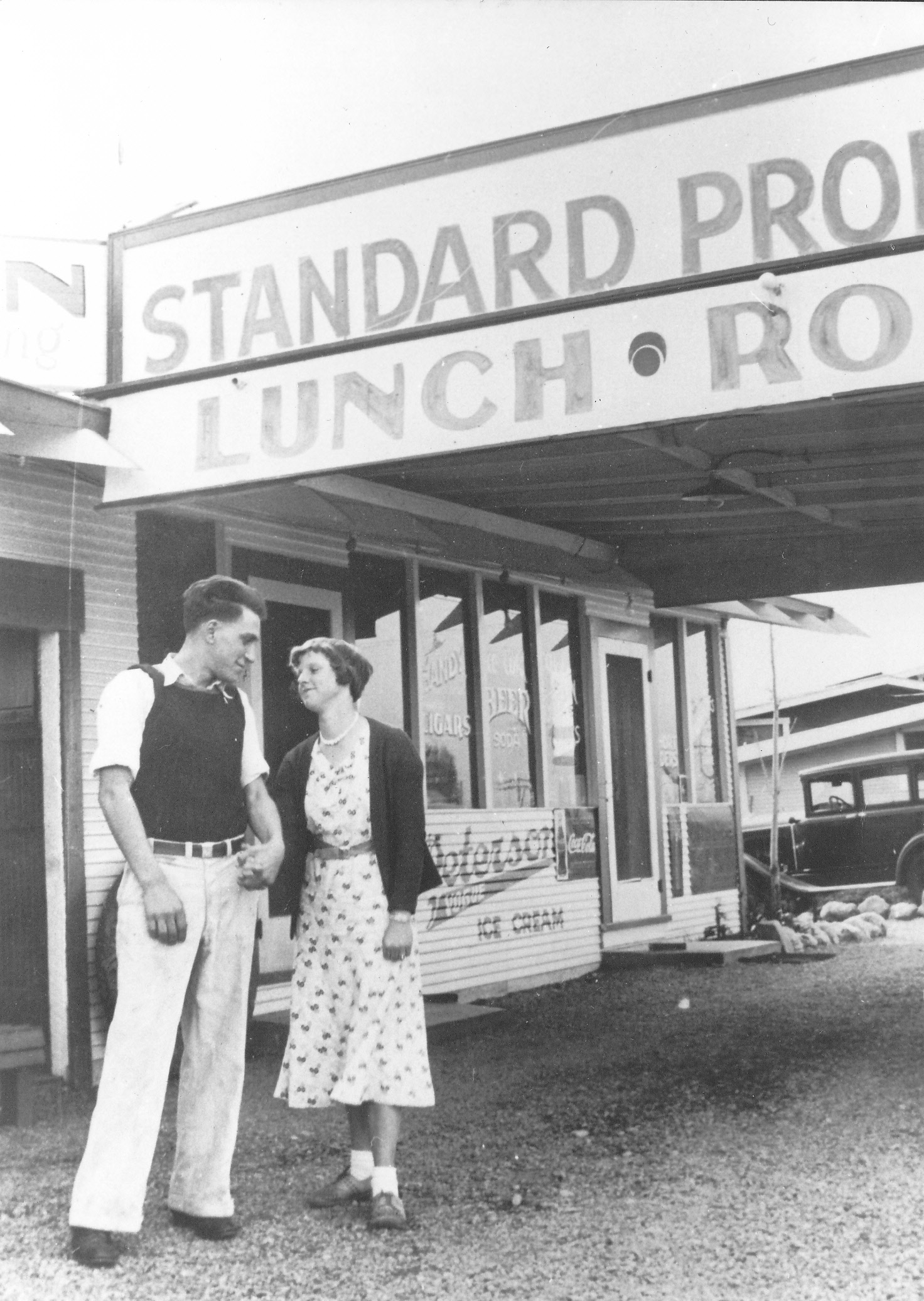
In the photo below, she and my grandfather at the service station in Tracy, California, that my grandfather managed.  It was probably taken in the late 1930s.

My Maternal Grandparents

Finally, this photo is a copy of the one that resided on my mother’s dresser when I was growing up, and is the picture that immediately comes to mind whenever I think of my grandmother.

Eliz age 17 - Copy

May you Rest in Peace, Elizabeth, and may we someday meet across the veil.

E is for Emigration (from Schleswig-Holstein)

SS Germania_Norway Heritage

SS Germania (1863) courtesy of Norway Heritage collection.

To the left is a photograph of the SS Germania, the ship Peter Nicholas Holst (my great-great grandfather) sailed on in May 1869 to the USA from Hamburg, Germany.

In the past year or so, I discovered a website listing persons who emigrated from Schleswig-Holstein during the 19th century.  This is a labor of love by a Klaus Struve who lives in Kiel, Germany.

The gist of these abstracted records, from a variety of sources, including Landesarchiv Schleswig, is that Peter Nicholas Holst was the son of Peter (which matches family oral history) and he had two younger brothers, Georg and Johannes (which matches the 1860 Denmark census).  Peter arrived in the U.S. in 1869 on the SS Germania – Hamburg and New York passenger lists confirm this.  Peter was a shoemaker, but also worked as a butcher in his early years in the U.S. in New York

According to the emigration abstracts, Georg (also noted as the son of Peter) stated [1] he would be joining his brother Peter Nicholas; he arrived in New York City in May 1872 [2] on the SS Vandalia.  I have found a possible source for a naturalization record (dated 1894) for Georg – otherwise, exactly nothing.  I do not know what happened to him.  He is not mentioned in Peter’s biography published in An Illustrated History of Sonoma County (pub. 1889).

Georg Holst NYC Passenger List

The youngest son of Peter, named Johannes, received permission to emigrate in 1872 [3].  But he did not sail to the U.S. until May 1873 [4] on the SS Holsatia, where he was going to meet up with his brothers Peter Nicholas and Georg.  As with Georg, I have no idea what happened next for Johannes.

Joh Holst NYC Passenger List

All that said, these abstracts have been fascinating and point to the possibility of other sources within the Schleswig-Holstein archives.  In addition, I may be able to find Johannes and Georg Holst in U.S. newspaper records, New York marriage records, or the 1880 U.S. Federal Census.  They don’t appear to have gone out to Sonoma County with Peter and Caroline, but did Peter and Caroline go out west simply because her brothers were already out there?  Did Peter’s brothers remain in New York / Connecticut?  Could more of Peter’s family (specifically, maternal cousins) have come to the U.S. as well?

More to research, now that I know Peter had brothers and that they actually did arrive in America…

[1]https://www.rootdigger.de/Names/H-file.pdf
[2] Passenger Lists of Vessels Arriving at New York, New York, 1820-1897, microfilm publication M237, 675 rolls (Washington, D.C.: National Archives and Records Administration, n.d.), roll 358, 20 May 1872, SS Vandalia, List 455, passenger 526, Georg Holst; digital images, “New York, Passenger and Crew Lists (including Castle Garden and Ellis Island), 1820-1957,” Ancestry (https://www.ancestry.com/search/collections/7488/ : viewed 27 Dec 2019), image 421.
[3]https://www.rootdigger.de/Names/H-file.pdf
[4] Passenger Lists of Vessels Arriving at New York, New York, 1820-1897, microfilm publication M237, 675 rolls (Washington, D.C.: National Archives and Records Administration, n.d.), roll 375, 15 May 1873, SS Holsatia, List 427, passenger 308, Joh. Holst; digital images, “New York, Passenger and Crew Lists (including Castle Garden and Ellis Island), 1820-1957,” Ancestry (https://www.ancestry.com/search/collections/7488/ : viewed 27 Dec 2019), image 14.

D is for my Danish roots

Sometimes when you put things off, it is all to the good because when you get back to it, circumstances have changed in a positive way.

In this case, more and more Schleswig-Holstein records have come online in recent years — and someone else has done the transcription of the Danish/Low German handwriting!

Thanks to the surge of online documents in the past few years, I’ve been able to extend my Danish great-grandfather’s maternal line and paternal line [Ahnentafel 28/29 on my pedigree].  This great-granddad is my mother’s maternal grandfather, a first-generation American.

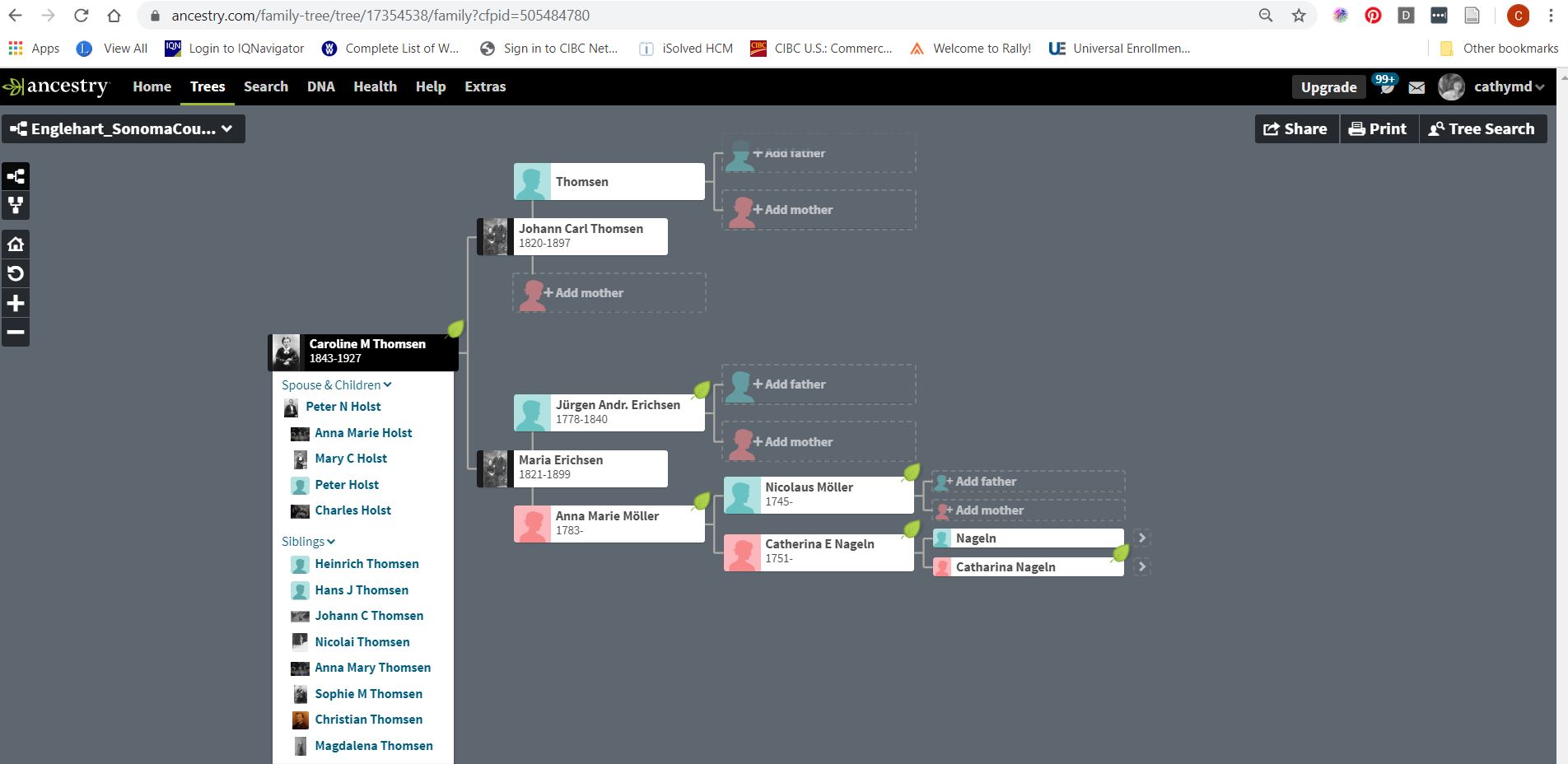
Caroline Thomsen Ancestors

My 2nd great grandma Caroline (Thomsen) Holst’s ancestors

Peter Holst Ancestors

My 2nd great grandfather Peter Nicholas Holst’s ancestors

One site I’ve used in recent years is Danish Family Search, wherein volunteers are transcribing the various censuses taken in Denmark.  And the duchy of Slesvig (my ancestral home) was part of Denmark until Bismarck invaded Slesvig in 1864 and, after the Austro-Prussian War in 1866, the territory was annexed by Prussia. [1]

Members of my own family headed to the United States during the decade or so, with my 3rd great grandparents, Johann Carl Thomsen and Maria Erichsen, both in their late 50’s starting all over leaving their home behind for the hills and valleys of Sonoma County, California.

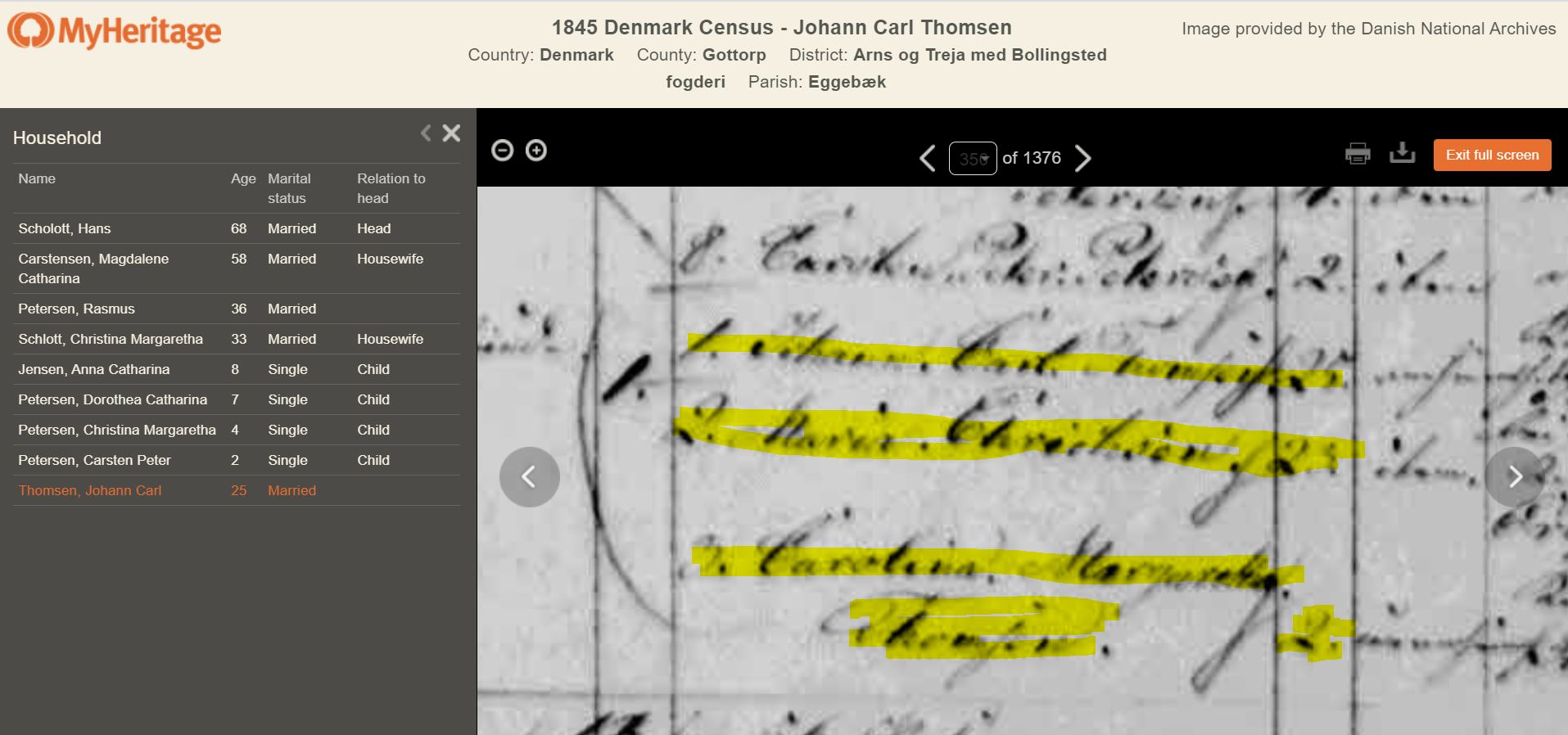
With respect to https://www.danishfamilysearch.com, I have built out a tree of my Danish line and added census records, where available, to it.  In some cases, the census records were already transcribed by volunteers.  More recently, I’ve been able to find Danish censuses online at FamilySearch.org [2] [3] and MyHeritage.com; those also have been transcribed.  Then I do a search at DanishFamilySearch, and add the applicable census to my family tree there, as well as doing a partial transcription of my own family’s household.


Highlighted in yellow above is Carolina Margaretha Thomsen, aged 2, with her mother Maria Erichsen, aged 23, and her father Johann Carl Thomsen, aged 25.

Peter Holst Household 1855

Above is a screen shot of the 1855 Denmark census for Peter Nicolai Holst, aged 8, with his younger Georg, aged 1, his mother Anna Dorothea Johannsen, aged 32, and his father Peter Holst, aged 34.  

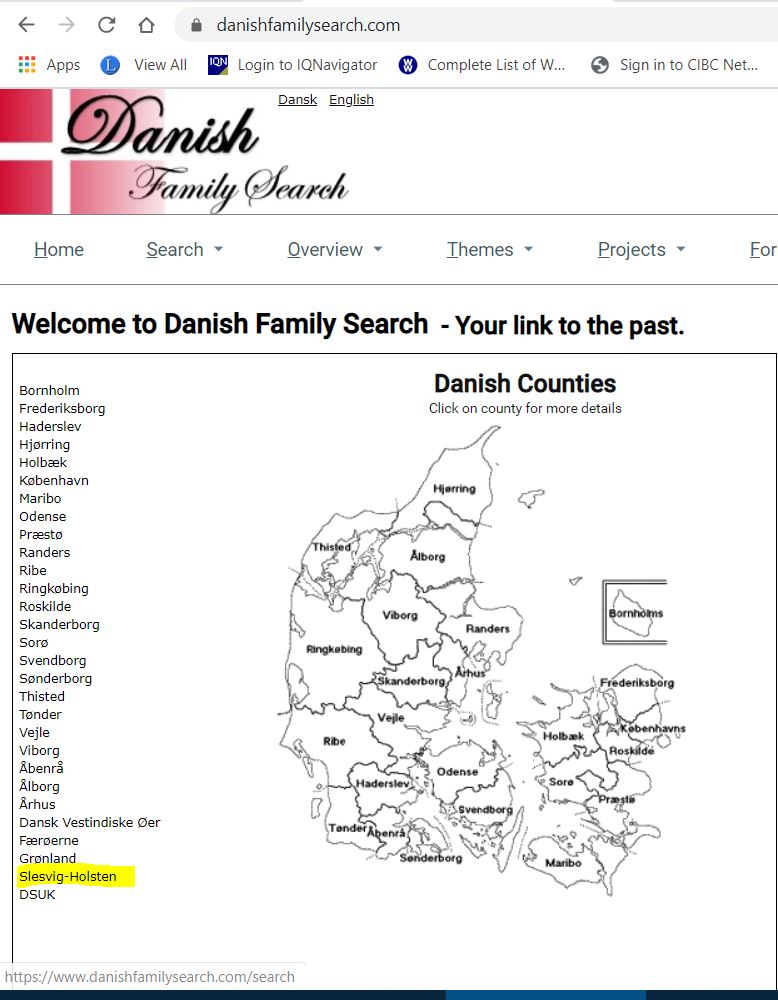
It’s certainly much easier to find my ancestral households now than 2 – 3 years ago, which is when I first began using DanishFamilySearch.  If you haven’t been to DanishFamilySearch, I’ll walk you through the site below.  Regions other than Slesvig-Holsten are likely to have more records (e.g. church books) available, simply because they are in the Danish Archives.  For Slesvig-Holsten, you also have to research in German archives.  You would select the county of interest on the main page — it’s a clickable link.

DanishFamilySearch1

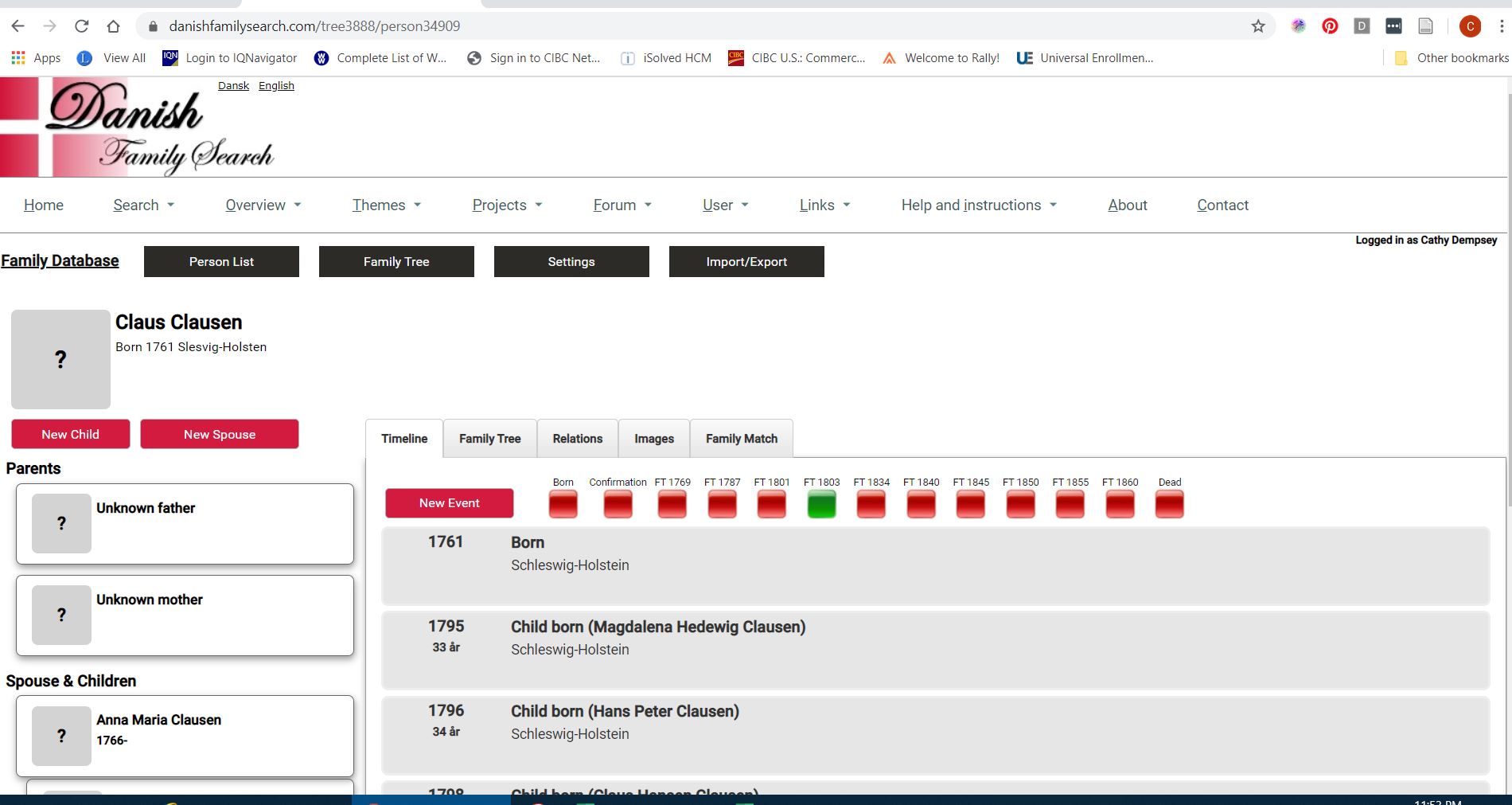
The screen below shows my family database entry for Claus Clausen, my 5th great grandfather.  Possible censuses available — not all are complete, nor all applicable for Slesvig-Holsten — are shown in the red boxes.  The green box means I have attached the 1803 census to Claus Clausen’s record.  (Clearly, as always with genealogy, I worked backwards to get to this point.)

ClausClausen1

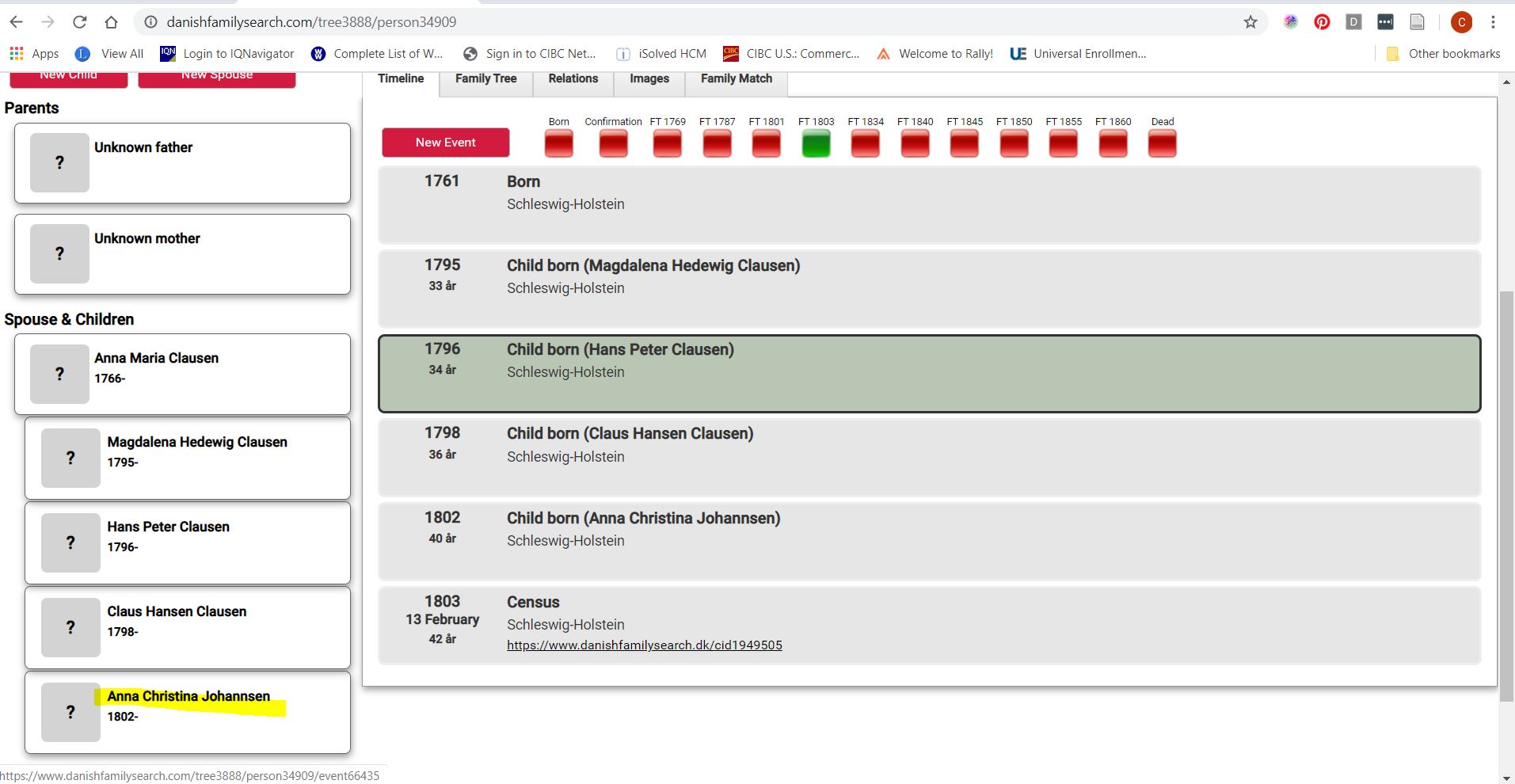
This screen shot shows all of Claus Clausen’s children as of the 1803 census.  If there were more, I won’t find them on the census, as the next available census is from 1835.  Anna Christina Johannsen is highlighted.  Johannsen is Anna’s married name.

ClausClausen_daughter

For those records which are pre-transcribed, the screen looks like this.  You do a typical search, filtering in what you know of your ancestor including first name, last name, age, county, administrative region and parish.   Below is Claus Clausen’s household in 1803.  They lived in Wees, within the Munkbrarup parish, in Flensbourg, in Slesvig-Holsten.  (Note that at the bottom is a reference to the Danish Archives online where the original record came from.)

ClausClausen_transcribed census

A Google Maps search of Wees, Germany shows the general location.

Wees Germany

Wees Germany 2

Grundhof (3 miles from the sea) and Dollerup, highlighted, are the hometown villages for another ancestral line.

The red pin below denotes Wees.  The black line just to the left represents the Denmark / Germany border.  The bays and fjords near Wees are part of the Baltic Sea. The city of Hamburg, which was the emigration point for my ancestors, is well south of this land area.

Wees Germany 3

A useful link for Danish censuses is:  https://www.familysearch.org/wiki/en/Denmark_Census , which includes links to the transcribed censuses on MyHeritage.com

I have also used Arbeitskreis Volkszahl-Register (http://www.akvz.de/index.html) in the past, but am currently struggling to properly query records which I have screen prints for, so something has changed in the past 2 years.  This group, too, is transcribing census and other records stored in Schleswig-Holstein archives in Germany.

What’s been most fascinating to me is to discover the names of the towns and parishes where my ancestors came from; I suppose the next step is to comb through church records, if available online.

[1] Wikipedia contributors, “History of Schleswig-Holstein,” Wikipedia, The Free Encyclopedia, rev. 4 Nov 2019;
(https://en.wikipedia.org/wiki/History_of_Schleswig-Holstein : accessed December 23, 2019).

[2] “Denmark Census, 1845,” database with images, FamilySearch (https://familysearch.org/ark:/61903/1:1:QLRV-3XYS : 23 Dec 2019), Johann Carl Thomsen in entry for Hans Scholott, Danmark; from “Denmark Census, 1845,” database and images, MyHeritage ( https://www.myheritage.com : 2016), film s00002; citing household 000275750, Rigsarkivet, København (The Danish National Archives), Copenhagen; FHL microfilm.

[3] “Denmark Census, 1855,” database with images, FamilySearch (https://familysearch.org/ark:/61903/1:1:QLD3-DZWV : 23 Dec 2019), Peter Nicolai Holst, Flensborg, Slesvig, Danmark; from “Denmark Census, 1855,” database and images, MyHeritage ( https://www.myheritage.com : 2016), film s00003; citing household 00000343271, Rigsarkivet, København (The Danish National Archives), Copenhagen; FHL microfilm.


Throwback Thursdays #tbt #wedding – My Maternal Grandparents

This photo is of my mother’s parents on their wedding day in Healdsburg, Sonoma, California on 22 November 1934.  My grandmother Elizabeth was just 20 years old (as of June that year) and my grandfather James was also 20 (as of October that year).

I believe they are standing in front of my great-grandparents’ house off Dry Creek Road, just west of Healdsburg.  The house was originally built by my great-great granddad Peter Holst after he and his wife Caroline and little girl Annie arrived in the area circa 1877 from where they had lived in Connecticut.

Throwback Thursdays #tbt #wedding – James Diamantini and his brothers

To pick up again on my Throwback Thursdays, I’ll continue with my Italian (maternal) side.

This photo is from 1976, when one of my uncles got married.  James Diamantini (aka Diamantine) is with his wife, Jean (Champi) Diamantine (parents of the groom), and also with his two older brothers, Gilbert and Frank and their wives.

Grandpa and his brothers and their wives

From left to right, Gilbert Diamantini (1904 – 1984; born in Sant’Elpidio A Mare, Ascoli Piceno, Marche, Italy), his wife Eleanor (Wold) Diamantine (1918 – 1981); Frank Diamantini (1909 – 1997; born in California), his wife Eva (Rose) Diamantini (1901 – 1989); Jean (Champi) Diamantine (1915 – 2016), and James Diamantini (1914 – 1995).