G is for Guernsey County, Ohio

Back to my “Family History from A to Z” series…

I’ve picked up my genealogy work after several years of sidelining it. I signed up for a SLIG 2025 (virtual) class on advanced methodology to be held in January, a second SLIG virtual class on writing to take place in February and March (weekly). Finally, most recently the Research Like a Pro e-course taught by the ladies at FamilyLocket.com after I first read their books at the library, and then bought the Kindle versions.

For the e-course, I am writing up research on my finding the father of my 3G grandmother Hannah (Hill) Englehart. I actually did the research years ago, came up with a father candidate, and that candidate (Andrew Hill) was ultimately validated via DNA. But I have only a research log, some scraps of notes, and skeletal citations, so I decided this would be a good project for this class to get me back in gear.

And one of the steps I’ve taken in the e-course — and part of the Research Like a Pro process — is to create a locality guide for my main research area. Because my 3G grandmother Hannah (Hill) Englehart was married in Guernsey County, Ohio (and apparently grew up there), I created a locality guide for that county. Additions to it are ongoing but what I have is below.

Guernsey County, Ohio Locality Guide

Prepared for Identifying the father of Hannah Hill Research Project by Cathy Dempsey; created 18 October 2024 (from a template created by familylocket.com

Background

Quick Facts

  • County Seat: Cambridge
  • Named for the Isle of Guernsey in English Channel, as many original settlers came from Guernsey
  • Formed 10 March 1810, from portions of Muskingum and Belmont counties
  • Ohio became a state on March 1, 1803, and was formed from part of the Northwest Territory (which was formed in 1787).
  • Countywide marriage and court records began in 1810, birth and death in 1867
  • Statewide birth and death records began in 1908
  • Ohio is a State Land State

Online Research Guides

Guernsey County, Ohio  – Family Search wiki

Guernsey County, Ohio: Family History & Genealogy, Census, Birth, Marriage, Death Vital Records & More – Linkpendium

Guernsey County Genealogy Guide – Random Acts of Genealogical Kindness

Guernsey_County,_Ohio (Wikipedia)  – Wikipedia

Archive Grid  ArchiveGrid is a collection of millions of archival material descriptions, including MARC records from WorldCat and finding aids harvested from the web.  

Geography and Maps

In 1851, lost Buffalo, Beaver, Olive and Seneca townships in the creation of Noble County to the south of Guernsey.

Neighboring Counties:  Coshocton (northwest), Tuscarawas (north), Harrison (northeast), Belmont (east), Noble (south), Muskingum (southwest/west)

Maps and Gazetteers:

Timeline of Major Events

Timeline of the area including major government changes and events

Ohio: Individual County Chronologies Newberry Library, 2007

The Historical Development of Guernsey County and Its Townships  Anderson, Scott C. R.  (USGennet.org)

History

History of settlement, links to history articles and books about the locality, major periods, military engagements,

Migration Routes

Describe main migration routes through your locality and link to maps and articles about the subject.

Principal Routes of Trade and Migration, 1840–1850  (accessed 18 October 2024)

https://www.familysearch.org/en/wiki/United_States_Internal_Migration (access 18 Oct 2024)

Law and Government

Old books that have been digitized (via Google Books, Internet Archive, Geneanet, etc.) that contain the laws and statues of the particular locality that you are researching; blog posts and articles about laws in your locality (check out the Legal Genealogist blog and library websites)

Libraries and Archives

Guernsey County
Administration Building
801 E. Wheeling Avenue
Cambridge, Ohio 43725-2335
Phone: 740-432-9230
Guernsey County Website

Guernsey County District Public Library 63500 Byesville Road
Cambridge, OH 43725

The Digital Archives of Guernsey Memorial Library

The Samuel D. Isaly Library  Bellville, Ohio [library of the OGS]

Ohio History Connection Archives & Library  Columbus, Ohio  [formerly Ohio Historical Society]

National Archives at Chicago    Serves Illinois, Indiana, Michigan, Minnesota, Ohio, and Wisconsin. 

Ohio State Archives

Genealogical Societies and Publications

Guernsey County Genealogical Society [Guernsey County Chapter of OGS]  Cambridge, Ohio

Ohio Genealogical Society   Bellville, Ohio

Record Loss

No known record loss.

Local History

Guernsey County History Museum Flickr Account: People  Guernsey County Historical Society

Guernsey County History Museum Flickr Account: Township Plats  Guernsey County Historical Society  (The images in this album are derived from a plat scan made available to the public by the Library of Congress)

Sarchet, Cyrus P.B.; History of Guernsey County, Ohio, (Indianapolis, Indiana: B.F. Bowen and Co., 1911). Volume 1 online at FamilySearch Digital LibraryInternet Archive; Volume 2 online at FamilySearch Digital LibraryGoogle Books

Wolfe, William G.; Stories of Guernsey County, Ohio: History of an Average Ohio County, (Cambridge, Ohio: W.G. Wolfe, 1943). Online at FamilySearch Digital Library

Reference Books

Additional books pertaining to research in this locality.

Record Collections

General Collections

Ancestry.com, FamilySearch.org, MyHeritage.com, FindMyPast.com etc. catalog titles about the locality

United States Record Finder on familysearch.org

Bible Records and Compiled Genealogies

Links to websites that have Bible records for the locality

Ohio Bible Records on familysearch.org

Cemetery Records

Links to cemetery records in the locality

Census Records and Substitutes

Links to different types of censuses: federal, state, town, colonial, territorial, census substitutes, etc.

United States Federal Census 1820 > Ohio > Guernsey

United States Federal Census 1830

Church Records

List the various denominations and where their records are kept.

Ohio Church Records — a general information page on familysearch.org

Determining the Church Your Ancestor Attended familysearch.org

Ohio, Church and Civil Births and Baptisms, 1765-1947  familysearch.org

Court Records

Links to court record collections and descriptions of what they contain

Guernsey County Clerk of Courts: Location of Court Records (Case Files, Docket appearances, etc.) PDF  — Guernsey County Clerk of Courts

Guernsey County Clerk of Courts homepage

Court records, 1810-1862 [Court of Common Pleas]  familysearch.org

Court records, 1811-1856 [Ohio Supreme Court]  familysearch.org

Ohio, Guernsey County, Common Pleas Journal and appearance dockets  [1829 – 1990] familysearch.org

Ohio, Guernsey County, Common Pleas Journal and appearance dockets, 1810-1938 at familysearch.org

Ethnic Records

List the various ethnic groups in the locality and what unique record collections are available about them.

Immigration and Naturalization

Describe immigration in the locality and link to the associated record collections.

Land Records

Land records were kept as of 1802

Ohio Land and Property  familysearch.org wiki

The Official Ohio Lands Book (pdf format)  Knepper, George W., pub. By Ohio State Auditor Office, 2002

The Northwest and the Ordinances, 1783-1858  Library of Congress (summarized history)

Land Ordinance of 1785  wikipedia.org

Northwest Ordinance of 1787  wikipedia.org

Guernsey County Recorder  – has land records

Deed records, 1810-1901; index, 1802-1968   familysearch.org

Guernsey County Township Maps  

Legislative Records

Link to collections about legislative records, if applicable, i.e. Virginia’s legislative petitions.

Military Records

Colonial, militia, war, regimental histories, etc.

Newspapers and Directories

Link to websites which contain digitized newspapers for your locality or how to find them if they aren’t digitized.

UF Digital Collections: Guernsey County (Ohio) Newspapers [early 20th century only]

The Digital Archives of Guernsey Memorial Library   OCR text is poor, with no option to fix as with CDNC. However, clicking on the link available allows you to see a digitized mage of the page.

Ohio Newspaper Archives 1795-2021  genealogybank.com

Probate Records

Link to record collections about will administration, probate, etc.

Probate records began to be kept as of 1812.

Ohio Probate Records, 1789-1996  familysearch.org    “Probate records and estate files from county courthouses in Ohio. The content and time period varies by county.”

Administration and execution dockets, 1812-1992  Probate Court (Guernsey County) on familysearch.org

Vital Records (Birth, Marriage, Death)

List the start of registration for birth, marriage, and death records. List any Gretna greens.

Birth and death records kept at the county-level as of 1867.  Marriage records kept as of 1810.

Birth records v. 1-3, 1867-1909, 1941-1963 Guernsey County Probate Judge; familysearch.org

Marriage records, 1810-1951, 1992-1997; index to marriages, ca. 1810-1930 Guernsey County Probate Court; familysearch.org

Death records, 1867-1960 Guernsey County Probate Judge; familysearch.org

Tax Records

Link to tax record collections, personal property tax, land tax, etc.

Guernsey County, OH Tax Duplicates 1816-1832  Guernsey County, Ohio Auditor. Familysearch.org

Looking forward to #SLIG2020

Have you ever attended a genealogical institute?

I am a genealogical institute newbie!  (I did sign up for IGHR for 2019, but then withdrew due to other commitments — a new job, actually.) So, when I did withdraw, I decided I absolutely would sign up for January 2020 SLIG (Salt Lake Institute of Genealogy) — it’s just too easy for me to slide into “bad habits” (searching instead of researching, mindlessly clicking on Ancestry tree hints, etc. ) unless I give myself regular doses of high-quality learning.

So, here I am back in Salt Lake City for the first time since 1994!  (I can’t believe it’s been that long.)  And it’s snowing, woo-hoo!  (At least it was when I arrived.)  Not a huge change for me, though, even given I’m arriving from Texas, as we had — surprise! — flurries, sleet and a light dusting of snow just yesterday!  

IMG_20200112_162040

The view from my window

So, this is my first time at a genealogical institute AND my first SLIG.  I’m signed up for Richard and Pamela Sayre’s “Advanced Research Tools: Land Records” class.  While I’ve used Deed Mapper, the BLM site for my ancestors in federal land states (esp. California, Missouri and Indiana), the land tract books on FamilySearch.org, I’m hoping this class will help me get the most out of land records in general and help clue me in on evidence I might be missing.  

I’ve heard nothing but positive things about the Sayres, although I have never attended a lecture or class presented by them before, so I’m looking forward to it.  They lead the class, but there will be other instructors assisting.  

Orientation starts shortly; I hope to meet up with some of my classmates from the BU Genealogical Certificate course I took in 2018 if not tonight, then sometime during #SLIG2020!


2020: a Look Ahead

Happy New Year!  2020 is here, and I’d like to use this post to jot down a few of my genealogy plans for this year (although in general I tend to steer away from resolutions and rigid adherence to goals).   

First — yay! — I am going to SLIG (Salt Lake Institute of Genealogy) for the first time.  It’s in January, and I will be taking a week of courses focusing on land records and deeds.  I’m psyched — and I hope also to spend some time at Family History Library, which I last visited in 1994.

The next item on my list for 2020 is participating in a National Genealogical Society Quarterly (NGSQ) / Mastering Genealogical Proof (MGP) Study Group that will meet once monthly on Tuesday evenings, led by Cari Taplin, CG, of Genealogy Pants.  The Tuesday evening group is full, but there is still availability in one of the other slots.  Click here for more info.

I’m also considering attending Jill Morelli’s Certification Discussion Group.  I had signed up for it last year, but then got a new job, so cancelled. 

My research focus will continue to my Copple / Wright (and related) lines in southern Indiana, and western North Carolina.

Finally, I’m hoping to write at least 50 posts to this blog in the coming year, completing two “A through Z” series.

With all that said, here’s the itemization from the beginning of 2019, and what I did (or did not) do.  Life zig-zags, and you just keep up as best you can.

Here’s a look back at my genealogy goals for 2019, made when I had just completed the BU genealogy course, and was still between bill-paying jobs.

Education and DevelopmentCommentsWhat were my Results?
IGHR (Athens, GA)week of July 21, 2019Signed up, then had to withdraw.  Signed up for SLIG 2020
Texas Institute of Genealogical Research 2019week of June 9, 2019Skipped this entirely; too busy at my bill-paying job.
Legacy Tree webinarsfocus on BCG-sponsoredAm a subscriber to FamilyTreeWebinars; watch these regularly.
Community and Colleagues  
join Assn of Professional Genealogists Renewed, but not actively involved in chapters, etc.
renew Indiana Genealogical Society membership Renewed, but not actively involved in chapters, etc.
renew NGS membershipdone — 2 year renewalcurrent through Nov 2020
join Texas State Genealogical Society Joined, but not active
start attending DGS meetings and get more involved in DGSattend meetings regularly in 2019Am currently the E-Newsletter Editor, and am a life member, but don’t attend meetings regularly.
DNA SIG meetings Have attended DNA SIG meetings occasionally but I generally use Facebook groups and Blaine Bettinger’s DNA-Central as my “SIG”
Writing (high-level)  
Evaluate: what do I know and how do I know it?for key (aka “brick wall”) ancestorsin process
Formulate a research question and a research plan for each of the “brick wall” ancestors (above) in process
Write up GPS proof summaries (or narratives) for each research question I’ve asked (and think I’ve answered) re: my ancestors’ lives on hold
DNA   
Continue mapping my chromosomesmy favorite thing!ongoing
Copple (family line) project on hold
Ask other cousins if they will consider testing  
Long-Range  
submit my lineage to Sonoma County Genealogical Society for a certificate (if approved)by the end of 2019maybe next year — not a priority right now
submit an article to NGSQthis is at least a year away 
get my CG designation — or my AG designationthis is at least a year away 
apply to and complete Pro Gen study coursetypically a 6 month wait list, after you apply.  Offered 3 x a yearOn the waiting list since February 2.

Happy New Year to you and yours!  


Happy First “Blog-i-versary”!

One year ago today I started this blog.  I had intended to write regularly — at least once a week — and I do, in fact, have 52 posts.  (Although I’ve arguably cheated a bit with my “Throwback Thursdays” series look at family photos, and my more recent “Copples in the News” series on Fridays. 

With one year under my belt, I thought I’d look at my blog stats.  What’s my most popular post?  How many people have visited, and from where?  Let’s see…

Here’s a graphic of all-time views and all-time individual visitors.  I have to see all these numbers are much higher than I expected since I’m primarily focused on my own family history and what I’m learning with DNA.

Blog Stats Views

What countries are they from?  I’m guessing WordPress counts spammers, too? (Not sure, but I suspect so.)


Blog Stats Countries1

Finally, my most viewed post (after the main page) was my review of the BU Genealogy Certificate class.  Fully 25% of the visitors to my blog this past year checked that out.  The next top 5 posts viewed all related to DNA — specifically clustering matches, Blaine Bettinger’s Shared cM Project (which is ongoing as of this writing), and 23andMe’s ethnicity update.

I haven’t kept up well with the “52 Ancestors in 52 Weeks” series.  That’s okay.  It’s going to hold limited appeal — unless one of my ancestors is also yours.  The top-rated post in that series (which I did not do for a full 52 weeks!) was the very first one, featuring my maternal grandmother who died at the age of 26.  Fitting, really, because in many ways, it was the fact that my own mother knew fairly little about her that got me started in genealogy.

So, for the next year, while I’m still going to continue my “Copples in the News” series, and post more of my research, I will certainly post about what I learn by clustering my own matches, as well as those of my dad and my mom.  I hope it can help others.  We can all learn together! 


Thank you for reading, and here’s to another year of learning about our genes and our roots!

Triangulation vs. “In Common With”

This question came up in one of the posts in Blaine Bettinger’s Facebook Group Genetic Genealogy Tips & Techniques, so I thought I’d give a quick example here that I refer to myself when I get confused.

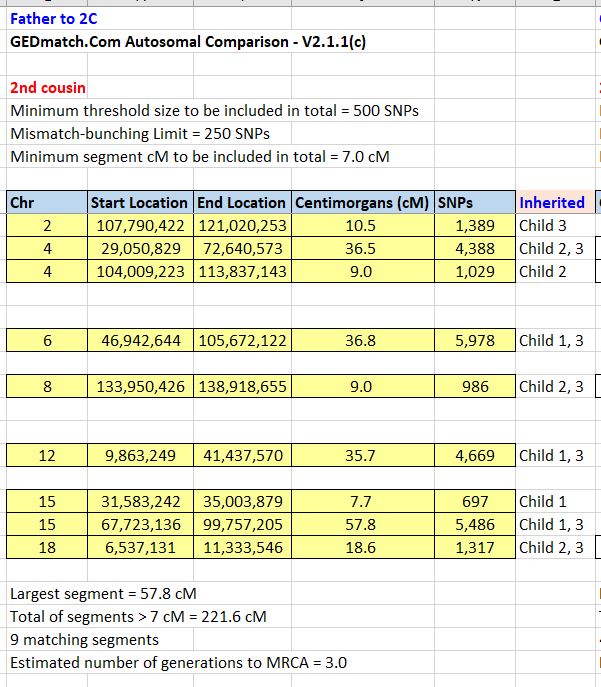
A man with 3 children, who have all tested, has a match to a 2nd cousin (documented through now through both DNA and traditional genealogy).  He and the 2nd cousin share 11 segments of DNA.

It so happens that all 11 of those segments have passed down to those 3 children, which you can see in the illustration below.  Of those 11 segments shared by their father and his 2nd cousin, Child 1 inherited 4 segments.  Child 2 also inherited 4 segments — but an entirely different four segments than Child 1.  Child 3 inherited 7 of the 11 segments.

The inheritance and sharing is illustrated below, in data pulled from GedMatch.

Inheritance

For purposes of illustration, we’re setting aside the fact that generally, when triangulating to find a common ancestor, we don’t use two full-blooded siblings as 2 of the triangle legs; they are too closely related, and will triangulate on many segments.

That said, Child 1, Child 2 and their 2nd cousin once removed (2C1R) have DNA in common with each other, but no triangulated segments with their 2C1R.  This is because Child 1 shares DNA with 2C1R on chr 6, on chr 12 and 2 segments on chr 15, while Child 2 shares DNA with 2C1R

Child 1, Child 3 and their 2C1R have 3 triangulated segments: on chr 6, on chr 12, and 1 segment of chr 15.

Child 2, Child 3 and their 2C1R also have 3 triangulated segments: on chr 4, on chr 8, and on chr 18.

*******
And that is a quick overview of triangulation vs. in common with.


The Shared cM Project: Tracking individual contributions

Do you know about Blaine Bettinger’s Shared cM Project?  It’s the crowd-sourced collection of shared centiMorgans (cMs) for the purpose of analyzing the ranges of cMs found at different levels of relationship (full siblings, half 1st cousins, 2nd cousins, etc.)

If you and your known relatives have done your DNA tests at any of the big vendors, you can submit your data here.  Relationship is asked for, but no identifying information (except your email) is needed for submission.

I have been submitting my own DNA data since 2016 — Blaine released the first results in May 2015.   However, so that I won’t skew the results (with duplicate or triplicate submissions), I keep track of my submissions in my own Excel spreadsheet.  A sample of the page I use is below, filtered on just some of the 2C1R relationships I have submitted.  (I have hidden the names of the two testers involved in each relationship.)

Submission_Shared cM Project

Note that the cM range for my submissions of 2nd cousin 1 removed is from 32 cM to 267 cM.  The vast majority of relatives at this level were known beforehand, or otherwise targeted tests.  In the case of the tester who only shares 32 cM, they share that cM with one of 1st cousins.  The rest of us — my siblings and I — and my 1st cousin’s siblings share a much more “typical” amount of DNA with the tester, around 110 – 140 cM.  And since we all match at the full-sibling level, and at the full 1st cousin level, it (so far!) appears that the 32 cM is just due to the randomness of DNA inheritance.

One thing I did in the beginning was submit a relationship for each vendor.  (My father, for example, has tested at 23andMe, FTDNA, and Ancestry, as have I.)  So, originally, I submitted 3 different sets of father/daughter data.  (Obviously, the cM count varied in only minor amounts.)

Since mid-2017, though, I only submit once no matter how many places the two testers have tested at.  (Blaine does ask for the vendor name when you submit.)

In general, I have said no endogamy — but that is based on what I know of the relationship.  Who knows?  With enough research on certain lines, I may find that indeed there was endogamy.

I also, for my own interest, track “expected” DNA shared with actual DNA shared (assuming grandparents and uncles/aunts share an average of 25% with the tester, first cousins share an average of 12.5%, 1st cousins removed (1C1R) 6.25% and 2nd cousins 3.13%.)  It never fails to amaze me how my sister, brother and I have such variations in the amount of cM shared with a given targeted cousin.

How do you track your submissions, if you are submitting to the Shared cM Project?  Are you concerned with not submitting twice — or do you figure it will all average out in the end (certainly a possibility)?

Cite/link to this post: Cathy M. Dempsey, “The Shared cM Project: Tracking individual contributions” Genes and Roots, posted 31 Mar 2019 (https://genesandroots.com : accessed (date)).


My review of the B.U. Certificate in Genealogical Education course

This past fall I took the Boston University Certificate Program in Genealogical Research.  This is a 15-week online course (for continuing ed credits only — NOT undergrad academic credit) taught by experts and professionals in the field of genealogy. 

The program was updated and modified with my class (Fall 2018).  It now has 4 modules:  (1) Genealogical Methods (5 weeks); — taught by Allison Ryall
(2) Evidence Evaluation & Documentation (4 weeks); — taught by Julie Michutka
(3) Forensic Genealogy (4 weeks);  — taught by Melinde Lutz Bryne, CG, FASG
(4) Genealogy as a Profession (2 weeks). — taught by Angela Packer McGhie, CG

Assignments were due each week, and were graded.   In addition, you are expected to log on regularly, and to participate regularly in discussions that are part of each module.  You need a grade of C or better in each module, and a B- overall to attain your certificate.  (Note: this is just a certificate.  It does NOT mean you are a Certified Genealogist through the Board for Certification of Genealogists.)

Getting on to what I thought of the course, I loved it!  It was well worth the cost (close to $2,700 — but I got 10% off, as I am a member of National Genealogical Society).  I did NOT take the 7-week Essentials course suggested by BU in advance of this course, deciding instead to just take the plunge.  I definitely needed a minimum of 20 hours per week to get through this course — but some weeks were more intense (citations!) and other weeks were “easier” (for me, that was the first module).

While I can’t make specific remarks as to the course content, my suggestion is that you are best off in the first module if you are familiar with a wide variety of records and have a high-level understanding of how DNA matches play into genealogical research.with DNA.    The module on evidence and citations has a new textbook — Thomas Jones’ Mastering Genealogical Documentation.  You are taught the art of citing your sources by understanding the source itself and the information within it — so you won’t have to just refer to templates.

The Forensic Genealogy module includes a focus on Ethics, since ethics play a significant role in dealing with living people, as far as DNA research and (financial) inheritances are concerned.  Finally, the module of Professional Genealogy covers the basics of what it takes to be a professional genealogist, using the brand-new Professional Genealogy: Preparation, Practice & Standards (published in 2018).

I found all the instructors (and their assistants) to be extremely responsive to my fellow students and myself.  I also thought the interaction between the students via discussion forums to be extremely helpful, learning as much from my classmates as from the coursework itself.  (The interaction between classmates is limited to the group you’re in, however; there were enough enrolled students for Fall 2018 that the students were divided into 2 sections, and further divided into 5 subsections of roughly 25 students each.)

All in all, if you want to ramp up your genealogical research skills very fast, this is a great course in which to do it.  Be prepared for a “grind” — you’ll likely need those 20+ hours a week to work on the readings and assignments.  There were about 4 or 5 in my own subsection of roughly 25 students that apparently dropped out before the end of the first module.  Afterwards, if you earn your certificate, you can choose to join the alumni mailing group (which includes alumni from all the past classes, back to 2009); a Facebook group exists as well.


Genealogy Goals for 2019

I’ve never been one for rigid goal-setting, or resolutions. (Hey, my Myers-Briggs type is INFP — and we “P” people like to keep our options open!)

That being said, I’m in a fairly unstructured time in my life right now; a little structure will keep me focused. And the cherry on top is to post my plans here.

Here’s to an awesome 2019! Happy New Year!

Education and Development Comments
BU (online class) for Certificate of
Genealogical Research
completed Dec. 2018
IGHR (Athens, GA) week of July 21, 2019;
registration opens 2 Mar 2019
Texas Institute of Genealogical
Research 2019
week of June 9, 2019
Legacy Tree webinars focus on BCG-sponsored
Community and Colleagues  
join Assn of Professional
Genealogists
done!!
renew Indiana Genealogical Society membership done!!
renew NGS membership done — 2 year renewal
join Tx State Genealogical Society done!!
start attending DGS meetings and
DNA SIG meetings
attend meetings regularly in 2019
Writing (high-level)  
Evaluate: what do I know and
how do I know it?
for key (aka “brick wall”) ancestors
Formulate a research question and a research plan for each of the
“brick wall” ancestors (above)
 
Write up GPS proof summaries (or narratives) for each research question I’ve asked (and think I’ve answered) re: my ancestors’ lives  
DNA  
Continue mapping my
chromosomes
my favorite thing!
Copple (family line) project  
Ask other cousins if they will
consider testing
 
Long-Range  
submit my lineage to Sonoma
County Genealogical Society for a
certificate (if approved)
by the end of 2019
submit an article to NGSQ this is at least a year away
get my CG designation — or my AG designation this is at least a year away
enroll in and complete ProGen
study course
typically a 6 month wait list, after
you enroll. Offered 3 x a year.