Lucile McDonald, a native of Collin County, Texas, married Earl Harold Copple in Kerr County, Texas (in what is known as the Texas Hill Country) on 17 February, 1941. She was 24 years old.
Her husband Earl was 32 years old and also a Texas native, being from Kimble County (adjacent to Kerr.) Earl was one of 10 children and the youngest son born to Virgil O. and Rosa (McDonald) Copple. Earl may be related to me twice over, as his paternal grandparents were cousins in some degree.
The bride was married in blue, with a corsage of pink carnations.
“McDonald-Copple Marriage Solemnized,” Kerrville Mountain Sun (Kerrville, Texas), 20 Feb 1941, pg 2, col 3; Newspapers.com (https://www.newspapers.com : accessed 21 June 2020).
As is the case with everyone who has had a DNA test at Ancestry, my small matches are gone. (However, I did go through the match list of my parents and my sibling and 1st cousins, “saving” small matches that were of interest (like “Thru Lines” matches) by marking them with a group identifier or making notes.
For me, the issue was removing old notes for small matches where I had indicated “doesn’t match mom or dad” so those false matches would not be saved!
The blessing of having both your parents alive and willing to test means you can check any of your own matches to validate whether they match one of your parents (if your parents give you collaborator access). I had already determined — via 3rd party tools — that over 25% of my matches were invalid. Meaning they didn’t match one of my parents.
So, all in all, I’m not at all upset at losing matches. Especially if it speeds up server response time.
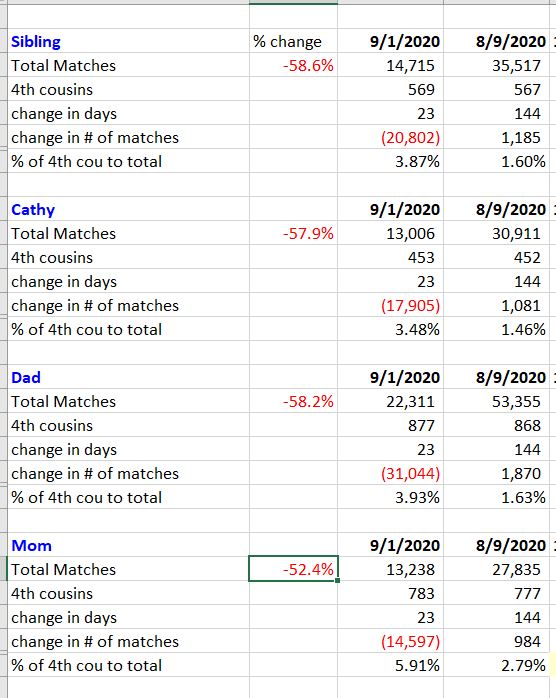
How many matches did my family members and I lose? Over 50% in each case!
The reduction in matches (everyone with < 8 cM of DNA shared) isn’t the only change. Ancestry also updated the number of shared segments with your matches. Mom and Dad still show more than the 22 autosomal segments they share in actuality, but it’s a lot closer. You can see that all he segment numbers go down for my matches with my closest kin.
My segments with my father were always fewer than with my mother. One reason is that there are fewer recombinations passed down from males, as I understand it. Another reason may be that my dad and I tested back in 2012, and therefore tested under a different version than my mother, who tested years later.
Here’s a list of my mom’s top matches, noting old number of segments compared to new number of segments. Segment number only changed when appropriate, so some of these 50 cM matches show no change.
The last change at Ancestry DNA was the addition of longest segment information. From what I’m hearing, this feature will be most useful to those who have significant endogamy in their ancestry (Acadian French, Ashkenazi Jewish, etc.) However, it can be useful if your match has tested elsewhere, and you have the chromosome segment information.
For the match below who has tested elsewhere, I already know that my mother’s (and mine, for that matter) primary segment match is on chr 9, and is hugely long (60 – 90 cM) per other vendors. So, seeing the below information validates that Ancestry shows the match on chromosome 9 as well, despite the fact they don’t tell you where you match.
The longest segment is calculated before Ancestry’s algorithms massage the data by removing “pile-up” regions (shared by many people) which are not considered genealogically relevant.
Beulah Elaine Copple, daughter of Henry Ellis Copple and Julia (Williams) Copple was possibly my 4th cousin 4 times removed (a descendant of Nicholas Copple who died in 1808 in Rowan County, NC, and his wife).
Beulah was born in 1892 in South Carolina, married Rev. Samuel Long in 1916, and had two sons. She died at the age of 50.
The wedding notice ran to two columns, and was quite detailed about what the bridal party wore. Here is only the first column.
“Monroe [Beulah Copple marries Sam Long],” The News and Observer (Raleigh, North Carolina), 3 Sep 1916, pg 7, col 6; Newspapers.com (https://www.newspapers.com : accessed 31 August 2020).
Today, August 17, 2020, it is 80 years since my grandmother died at the tender age of 26 — an age I reached and passed decades ago. Such a short life!
My heart hurts for my mother, who was only a toddler and never got to know her mother, and my heart hurts for my grandfather who was only 25 when he lost his wife. I wrote about her here in this blog.
In the photo below, Elizabeth is the second from the left amongst her high school friends, and, to my mind, the resemblance between her and my own mother is quite strong.
In the photo below, she and my grandfather at the service station in Tracy, California, that my grandfather managed. It was probably taken in the late 1930s.
Finally, this photo is a copy of the one that resided on my mother’s dresser when I was growing up, and is the picture that immediately comes to mind whenever I think of my grandmother.
May you Rest in Peace, Elizabeth, and may we someday meet across the veil.
Hurray! It’s finally arrived! My dad and I took Ancestry DNA tests 8 years ago in the fall of 2012, and it’s always bugged me that Ancestry said we shared 55 segments of DNA when we know the true biological number is 22 shared autosomes and 1 shared X chromosome, the full length of the chromosome. So we should have seen 22 all these years (because X isn’t counted).
Well, it still isn’t 22, but it’s a darn sight closer!
The shared segment count with Mom is still pretty far off, but at least it’s not 77 any more. I suspect the count is due to Ancestry’s algorithms and/or the chip that was used for her test which was done in fall 2018. Mom also tested at FTDNA (a native kit, not a transfer) and that FTDNA test was the one uploaded to MyHeritage; they’re largely in agreement as one would expect.
The 1st cousin relationship looks fairly consistent the board.
I also noticed that the segment count for my Mom’s Ancestry matches mostly remained the same past 2nd cousin, down to matches of 30 cM, while my matches and my Dad’s matches down to 30 cM showed more adjustment in the segment numbers. Just a fluke? Or something to do with the testing chip used?
Did you see changes? There are polls being done at the Genetic Genealogy Tips and Techniques Facebook group here.
In the midst of this current coronavirus epidemic, I wondered if any of my distant Copple kin had suffered from influenza during the 1918 pandemic. I know my great-grandmother’s brother, George Englehart, was a victim of the 1918 flu; his mother was a Copple. But that’s a separate story.
A search on newspapers.com brought up little 8 year old Clifford Copple dying in Nov 1918 in Coos Bay, Oregon. He was my 4th cousin 3 times removed, twice over. Born to William Alonzo and Frances R (Center) Copple, he had two sisters and four brothers. A number of his paternal extended family lived in the area, originally coming to Oregon by way of Washington, Illinois, Missouri and Indiana.
Clifford apparently suffered from influenza in the fall of 1918 — which would have been during the “second wave“. (So it is quite possible — but unknown — if members of his family had it as well.) However, he recovered, and then came down with meningitis, which was fatal to him.
Little Cliff’s death (and possible illness of other family members) probably wreaked havoc on William and Frances’ marriage. As of the 1920 census (on April 1st), Frances was living with her children and her marital status was listed as “widowed” (although William did not die until 1928). By May 1920, Frances had married James Weaver Cole.
Clifford’s great-great grandparents were Jacob [Peter] and Elizabeth (Wright) Copple. Jacob Jr. was the son of Jacob [Peter] Copple and Mary Elizabeth Garren [or Foutz?], who are also my ancestors.
Elizabeth (Wright) Copple was the daughter of Benjamin Wright and Barbara Morgan. Benjamin was the son of Richard Wright and Ann [unknown surname], who are also my ancestors.
“Son of W.M. Copple Dies,” The World (Coos Bay, Oregon), 16 Nov 1918, pg 6, col 1; Newspapers.com (https://www.newspapers.com : accessed 20 March 2020)
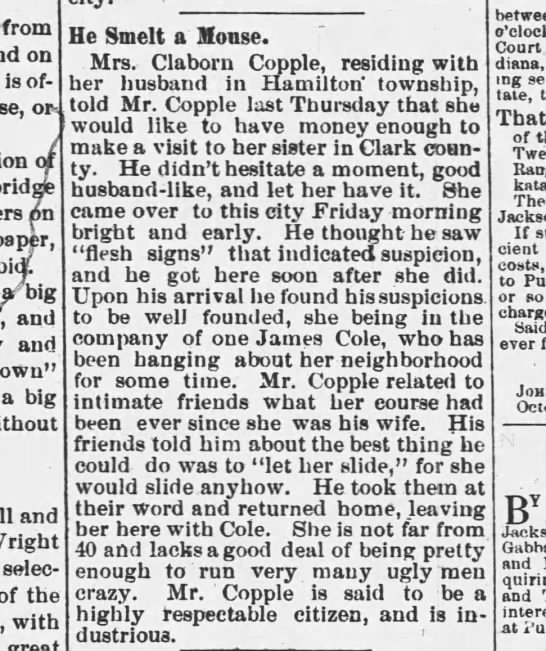
As best as I can determine, Claiborne Copple of Jackson County, Indiana — who, in this article is apparently suspicious of his wife’s fidelity — is a possible distant cousin of mine via his father David (1794 – 1835) and grandfather John (1768 – 1838).
Claiborne was born circa 1827 probably in Kentucky (but possibly in southern Indiana), likely one of at least 10 children. He married Mary Holt, his first wife, in Clark County, Indiana in 1856, and resided in Clark County at the time of the 1860 census. By 1863, though, when he signed up for the Civil War draft, he was in Jackson County, Indiana. His wife died circa 1876, and he remarried to an Elizabeth King in 1877.
He was found in the 1880 census in Jackson County, Indiana. (As an aside, I have not found any information on when he died, nor have I found him on the 1850 and 1870 censuses.) It is apparently wife #2 (Eliza) who was “in the company of James Cole”.
“He Smelt a Mouse,” Jackson County Banner (Brownstown, Indiana), 2 Nov 1882, pg 5, col 4; Newspapers.com (https://www.newspapers.com : accessed 7 February 2020).
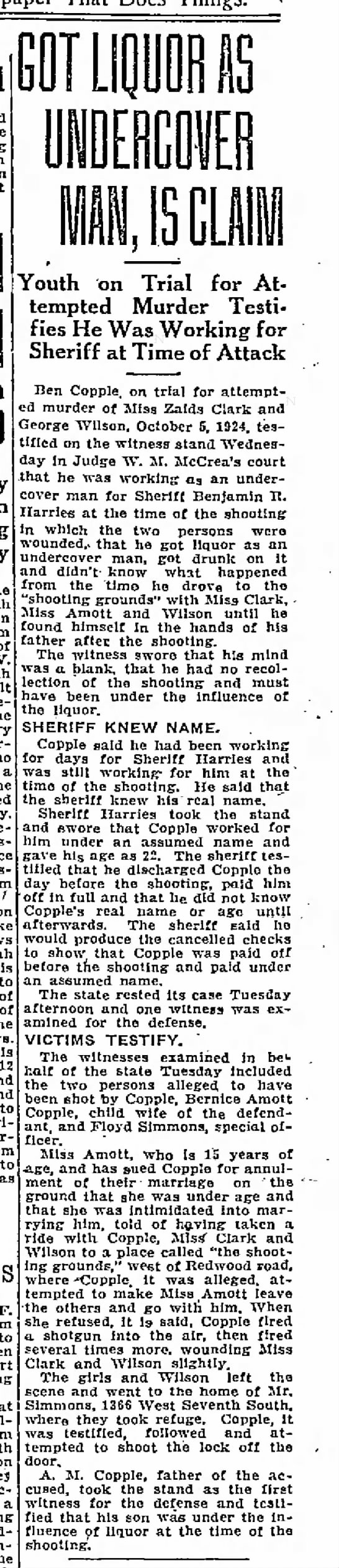
In October 1924, a teen-aged Benjamin Garl Copple (c 1906-1986) was accused of attempted murder of a young woman and man, while he was under the influence of liquor. Ben was married at the time, to a Bernice Amott his “child bride”, who was only 15 at the time of the article in February 1925. Ben had reportedly been working for the sheriff until the day before, under an assumed name (not given in the article) and an assumed age (22). His father, A. M. Copple [Alpheus Marvin] testified on his behalf.
Ben Garl Copple was born sometime between 1903 and 1907 probably in Colorado to Alpheus Marvin Copple (1881 – 1944) and Lucinda Mary Whitlock (1884 – 1978), both natives of North Carolina. The family was living in Las Animas County, Colorado in 1910, and in Salt Lake City in 1920.
After the shooting incident in October 1924, Ben married Bernice Amott (who was with him on the day of the shooting, per the article below) on 26 January 1925. The article states Bernice was filing for an annulment of the marriage and that must have gone through, as Ben married Edith Olga Shafer on 27 June 1925.
The 1930 census found Ben and Edith, with their daughter Joyce, in Salt Lake City, and Ben worked as a laborer. In 1940, they were in the Los Angeles area, where Ben worked as a truck driver.
Benjamin Garl’s paternal grandfather shared the same name as my 3rd great grandfather: Benjamin Franklin Copple, but that Ben Copple lived his entire life in North Carolina. Ben Franklin Copple’s parents were Henry and Frances “Franky” (Miller) Copple. Henry’s parents are unknown; however Frances Miller’s father Isaac Miller lived in the vicinity with 3 Copple households in Davidson County, NC, which I’ve traced as my kin. It is possible — but not certain — that Henry’s parents were Jacob Copple and Delilah Plummer.
If so, these Salt Lake City Copples are distant cousins to me.
“Got Liquor as Undercover Man,” Salt Lake Telegram (Salt Lake City, Utah), 18 Feb 1925, pg 2, col 8; Newspapers.com (https://www.newspapers.com : accessed 13 January 2020).
Glenn Copple (1888 – 1965) was appointed Deputy to Yuma County (Arizona) District Attorney Henry C. Kelly.
Glenn was born in Nov 1888 in Centralia, Illinois to Silas Bryan & Julia (Roper) Copple, who married in 1884. He was their second son. Silas Bryan Copple’s paternal great-grandparents were Jacob [Peter] Copple and [Mary] Elizabeth Garren [Pfoutz?], who are my 6th great-grandparents.
Glenn was in the military from Aug 1917 to July 1919, and after arriving home back in Centralia, was a lawyer. He moved to Yuma, Arizona prior to January 1925, which is when he became the assistant District Attorney.
He married Janet Anne Burnell in 1934 in Phoenix, Maricopa County, and they had a son Gordon Burnell in April 1936 in Los Angeles County, California. The family was back in Yuma County, Arizona as of the 1940 census. Glenn died in Oct 1965, presumably in Arizona, but is buried in San Diego County, California. His widow died in 1982, and his son Gordon died in 1987 at the age of 51.
Glenn was my 3rd cousin 4 times removed.
“Attorney Glen Copple is Named,” The Morning Sun (Yuma, Arizona), 2 Jan 1925, pg 1, col 6; Newspapers.com (https://www.newspapers.com : accessed 13 January 2020).
I am a genealogical institute newbie! (I did sign up for IGHR for 2019, but then withdrew due to other commitments — a new job, actually.) So, when I did withdraw, I decided I absolutely would sign up for January 2020 SLIG (Salt Lake Institute of Genealogy) — it’s just too easy for me to slide into “bad habits” (searching instead of researching, mindlessly clicking on Ancestry tree hints, etc. ) unless I give myself regular doses of high-quality learning.
So, here I am back in Salt Lake City for the first time since 1994! (I can’t believe it’s been that long.) And it’s snowing, woo-hoo! (At least it was when I arrived.) Not a huge change for me, though, even given I’m arriving from Texas, as we had — surprise! — flurries, sleet and a light dusting of snow just yesterday!
The view from my window
So, this is my first time at a genealogical institute AND my first SLIG. I’m signed up for Richard and Pamela Sayre’s “Advanced Research Tools: Land Records” class. While I’ve used Deed Mapper, the BLM site for my ancestors in federal land states (esp. California, Missouri and Indiana), the land tract books on FamilySearch.org, I’m hoping this class will help me get the most out of land records in general and help clue me in on evidence I might be missing.
I’ve heard nothing but positive things about the Sayres, although I have never attended a lecture or class presented by them before, so I’m looking forward to it. They lead the class, but there will be other instructors assisting.
Orientation starts shortly; I hope to meet up with some of my classmates from the BU Genealogical Certificate course I took in 2018 if not tonight, then sometime during #SLIG2020!








 Genes and Roots